 ChatGPT
 Perplexity
 Claude
Cloud DevOps is not a tools shopping list, it is a measurable way to build and operate modern platforms that ship faster, break less, and cost less. This roadmap focuses on outcomes, not hype, and gives engineering leaders a pragmatic sequence you can execute over the next 30 to 180 days.
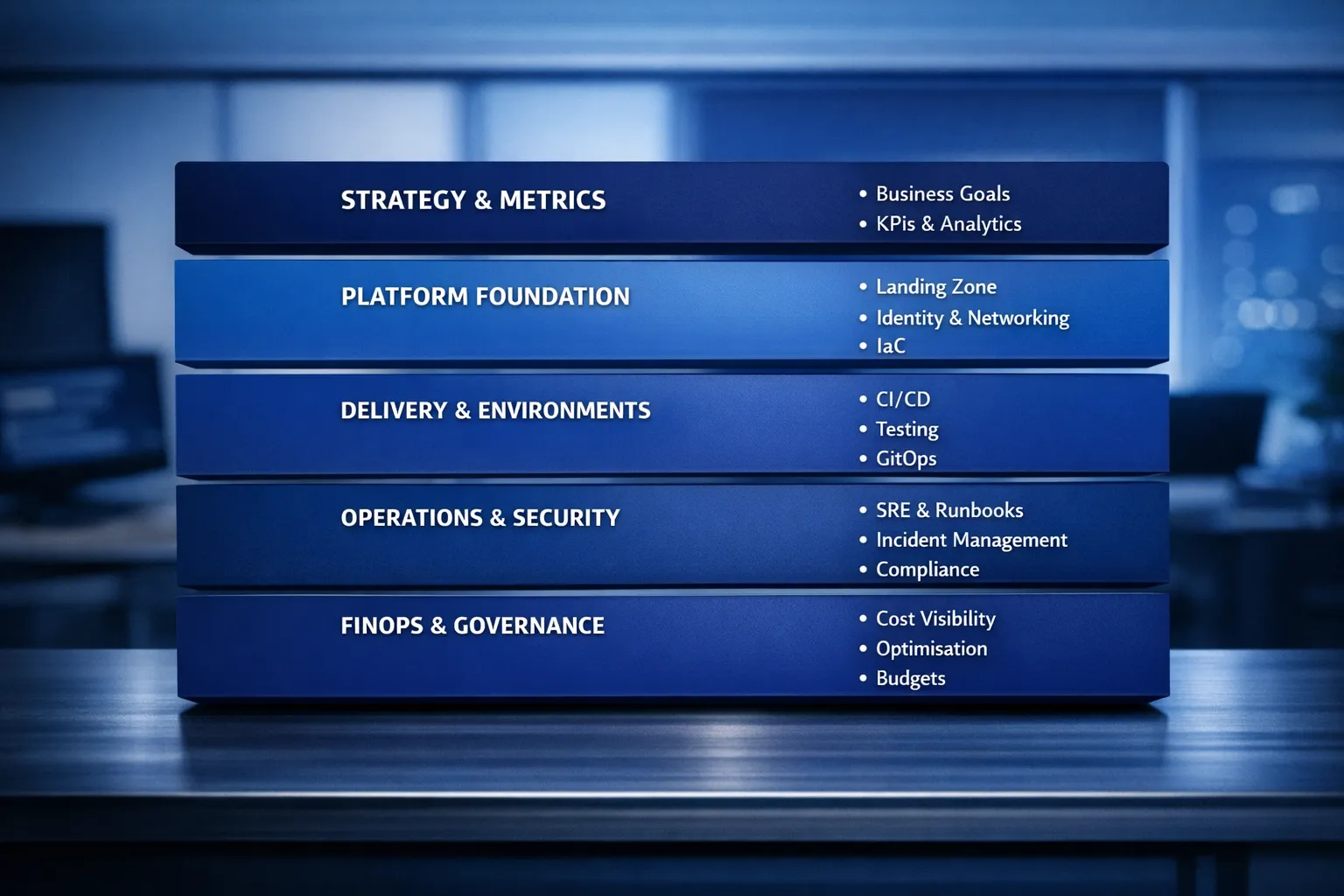
What counts as a modern platform in 2026
Modern platforms are the productised foundations that let teams ship safely at scale. They combine cloud infrastructure, delivery automation, observability, security, and self‑service developer experiences.
| Platform type | Examples | DevOps emphasis |
|---|---|---|
| Microservices on Kubernetes | User‑facing apps, B2B APIs | GitOps, progressive delivery, service mesh, SLOs |
| Serverless APIs and jobs | Event‑driven backends, data transforms | IaC, least‑privilege, event tracing, cost controls |
| Data and analytics platforms | Real‑time ETL, dashboards, ML features | Reproducible pipelines, lineage, storage tiers, encryption |
| Edge and IoT | Retail sensors, telematics | Fleet management, OTA updates, offline resilience |
| High‑throughput and gaming | Real‑time state, community servers | Auto‑scaling, latency SLOs, anti‑abuse, burst testing |
Even community‑run workloads illustrate core DevOps themes. Public directories of community servers, such as this curated list of French Minecraft servers, show how demand spikes, version drift and operational hygiene are everyday concerns that benefit from automation, observability and guardrails.
For deeper fundamentals, see our guide to cloud native patterns and pitfalls and platform practices for high‑scale teams.
The Cloud DevOps roadmap for modern platforms
This roadmap is sequenced to reduce risk and produce early, visible wins. Each stage lists key deliverables and proof that it worked.
Stage 0, align outcomes and measures (weeks 0 to 2)
- Define business outcomes and guardrails, speed, reliability, cost per customer, compliance boundaries.
- Select baseline metrics, DORA lead time and deployment frequency, service SLOs and error budgets, cost per service.
- Inventory the portfolio, environments, toolchain, skills and constraints.
Proof
- An agreed scorecard and 3 to 5 lighthouse services to pilot.
- A prioritised impediments list tied to outcomes.
Recommended reading, start with a DevOps Strategy and Assessment to avoid tool‑first anti‑patterns.
Stage 1, platform foundation as code (weeks 2 to 6)
- Landing zone and identity, accounts or subscriptions, baseline network, IAM, policies.
- Infrastructure as code, Terraform or Pulumi with remote state and PR reviews.
- GitOps bootstrapping, cluster or environment config declared in Git and reconciled automatically.
- Observability and logs at the platform layer, metrics, logs and traces for core services.
- Security baseline, secrets management, image scanning, basic policies.
Proof
- Idempotent environment creation from a clean repo.
- Tracing and metrics visible for the platform components.
Helpful resources, zero‑to‑cluster guidance with our Terraform EKS module walkthrough and an observability buyer’s guide.
Stage 2, delivery automation and environments (weeks 4 to 12)
- Standard CI templates, build once, test, sign, store artefacts, SBOM and supply‑chain checks.
- CD with progressive strategies, blue‑green or canary, automated rollback, environment promotions.
- Test strategy baked into pipelines, unit and contract tests, smoke tests, synthetic checks post‑deploy.
- Environment consolidation, ephemeral previews for PRs and fewer long‑lived pets.
Proof
- Deployment frequency increases without a spike in incidents.
- Median lead time falls release over release.
See our practical take on Cloud DevOps services and outcomes.
Stage 3, reliability, operations and security by design (weeks 8 to 16)
- SRE practices, SLIs and SLOs for key journeys, alert on burn rate, incident review with action items.
- Runbooks and automation, clear decision trees, safe automated remediation with guardrails.
- Disaster recovery and backup drills, defined RTO and RPO, game days to validate.
- DevSecOps, policy as code, shift‑left checks, secrets rotation, dependency and container scanning.
Proof
- Reduced MTTR and fewer out‑of‑hours pages.
- Successful chaos or DR exercises within targets.
Tactical guide, Cloud operations management with SLOs and automation and our cloud security checklist for 2025.
Stage 4, data, analytics and insights (weeks 10 to 20)
- Platform telemetry to insight, golden dashboards for flow, reliability and cost.
- Product analytics, event capture from apps into a governed pipeline, consent and retention built in.
- ML and feature pipelines where needed, reproducible training and rollouts.
Proof
- Teams self‑serve operational and product KPIs without ad hoc scraping.
- Decisions reference the same trusted numbers, less meeting time spent arguing about data.
Example outcomes, we cut a client’s API p95 from seconds to sub‑second with targeted database and caching changes, see the Vialto performance case study.
Stage 5, FinOps and sustainable operations (weeks 6 to 24)
- Cost visibility, tagging standards, CUR ingestion, per‑service cost dashboards.
- Optimisation levers, instance families, auto‑scaling, bin‑packing, storage tiers, right‑sizing.
- Guardrails and budgets, policies that prevent surprise bills and enforce ownership.
Proof
- Unit economics improve, cost per customer, request or job trends downwards.
- Variance reduces and forecasts become reliable.
Real savings, we delivered a 30 percent EKS bill reduction and removed an unnecessary gateway saving USD 100K. For a hands‑on playbook read Kubernetes FinOps and our AWS cost optimisation guide.
A practical 30, 60, 90‑day starter plan
Day 0 to 30, baseline and first wins
- Agree the scorecard and pilot services, define SLOs and leading indicators.
- Stand up the landing zone and IaC repo, enable basic observability and image scanning.
- Move one service to standard CI and CD, add smoke tests and progressive delivery.
Day 31 to 60, scale the foundation
- Roll out CI templates and CD patterns across two to three teams.
- Introduce GitOps for environment configuration and eliminate hand‑managed changes.
- Implement SRE incident workflows and first automated remediations.
Day 61 to 90, prove resilience and cost control
- Run a DR exercise and a small chaos game day.
- Turn on cost dashboards and implement two cost levers per service, rightsizing and storage tiering for example.
- Publish a quarterly platform report against the scorecard.
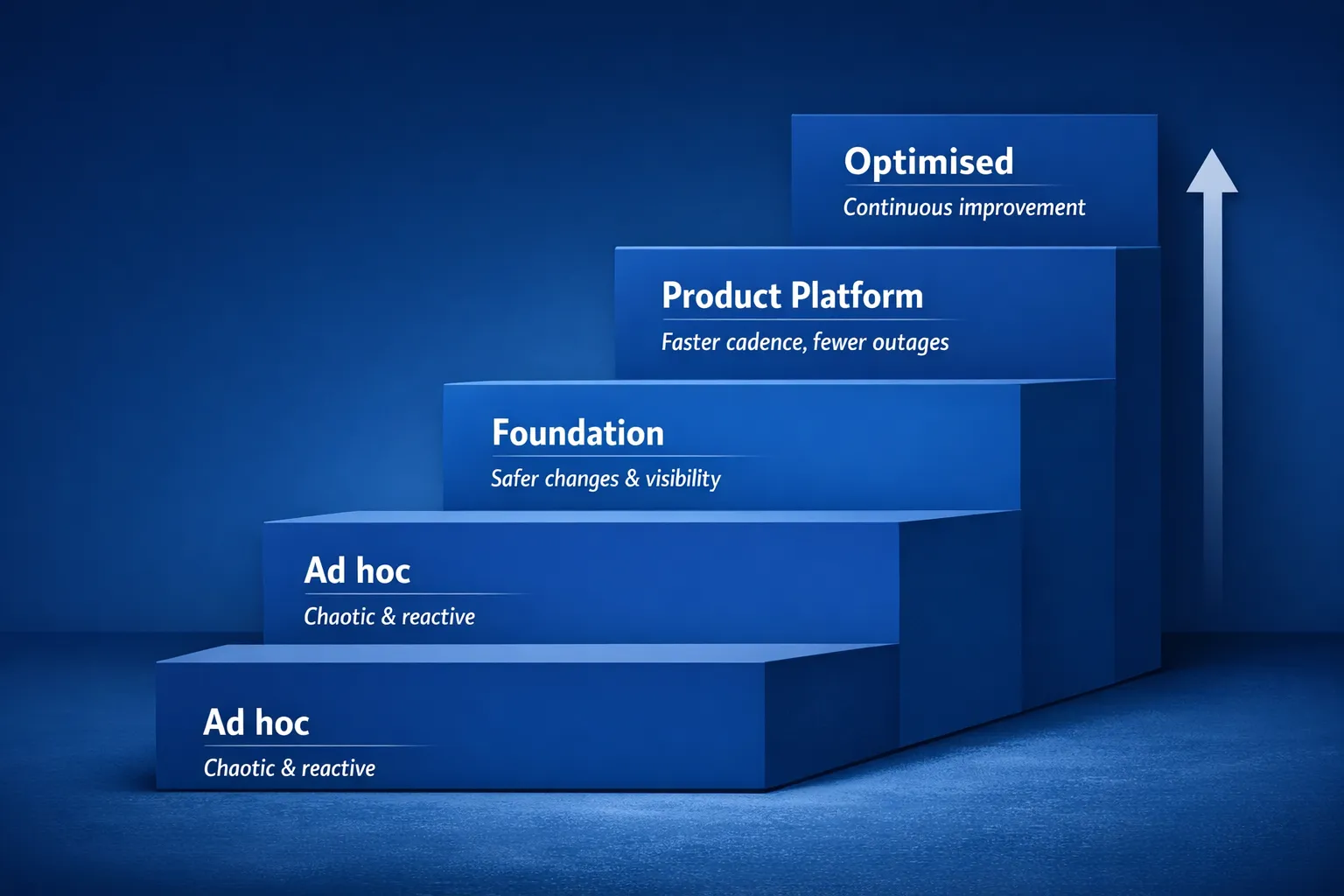
Platform maturity model
| Level | Name | Indicators | Outcomes |
|---|---|---|---|
| 1 | Ad hoc | Manual deploys, snowflake environments, little visibility | Fragile releases, unpredictable incidents, rising costs |
| 2 | Foundation | Landing zone, IaC, basic CI, shared observability | Safer changes, reduced toil, clearer bottlenecks |
| 3 | Product platform | GitOps, progressive delivery, SLOs, runbooks | Faster cadence with fewer outages, predictable recovery |
| 4 | Optimised | FinOps baked in, policy as code, self‑service IDP | Scalable delivery, reliable cost per unit, strong compliance |
Tooling reference architecture
Choose tools your team can own, automate and measure. A representative blueprint that balances openness and managed services looks like this.
- IaC and platform, Terraform or Pulumi, Git repository with mandatory reviews, GitOps controllers for cluster and environment config.
- CI, a standardised pipeline in GitHub Actions, GitLab CI or Jenkins with reusable templates, SBOM generation and signing.
- CD, Argo CD or Flux for pull‑based deployments, progressive delivery via canary or blue‑green and automated rollback.
- Observability, metrics and alerts with Prometheus compatible systems, traces with OpenTelemetry, dashboards via Grafana or a managed suite.
- Security, centralised secrets, static and dependency scans in CI, container image scanning at build and admission.
- FinOps, cost and usage data into a warehouse or Kubecost for K8s, budgets, alerts and policy.
If you need a step‑by‑step GitOps adoption plan, see our case study on consultant‑led Kubernetes migration and our primer on why teams migrate to Argo CD.
Common pitfalls to avoid
- Tool‑first programmes that ignore team topology and outcomes.
- Over‑engineering the first platform, complex meshes and policies before you deploy reliably.
- DIY migrations without architectural guardrails, often more expensive than consultant‑led or hybrid approaches, see the Kubernetes migration cost breakdown.
- No SLOs or runbooks, teams cannot manage reliability or automate remediation.
- Cost as an afterthought, enable tags and budgets at day one, not month twelve.
Proof points from the field
- 95 percent faster deployments and zero downtime after a consultant‑led K8s migration, mid‑market SaaS case.
- 30 percent EKS cost reduction with a safe blend of spot and on‑demand, travel sector.
- USD 100K saved by replacing an unnecessary enterprise gateway with K8s‑native routing, hospitality company.
These outcomes came from the same roadmap playbook, a measurable foundation, delivery automation, SRE discipline and FinOps guardrails.
FAQs
How is this different from platform engineering? Platform engineering is how you build and operate the platform. The roadmap is the sequence to adopt capabilities with evidence that each step worked. Most teams do both together.
Do we need Kubernetes to follow this roadmap? No. The stages apply to serverless, VMs and data platforms as well. Kubernetes benefits from GitOps and SRE practices, but the outcomes and measures are technology neutral.
What should we measure first? Start with a small scorecard, deployment frequency, lead time for changes, change failure rate, MTTR, and one unit‑economics metric like cost per request or per active customer.
How do we manage compliance without slowing teams? Codify controls early, identity and network guardrails, policy as code, automated evidence from CI and the platform. This reduces audit effort and keeps flow high.
When should we bring in external help? If you lack senior experience in cloud, security or SRE, a short assessment and a hybrid engagement often pays back quickly. Our case studies show consultant‑led migrations can save months and significant cost.
Ready to execute your roadmap?
If you want a pragmatic, outcomes‑first plan for your platform, we can help you baseline, prioritise and deliver measurable wins in 90 days. Explore our capabilities and success stories at Tasrie IT Services, or start with a lightweight DevOps and platform assessment to turn this roadmap into your delivery plan.