 ChatGPT
 Perplexity
 Claude
Engineering leaders are under pressure to ship faster without gambling on uptime, security, or cost. Cloud DevOps services align these goals by turning delivery, reliability, and governance into a single operating system for software. In 2025, the organisations that win are not those that chase every new tool, they are the ones that execute with discipline, measurable outcomes, and platform thinking. For a concise view of where the industry is headed, see this overview of software development trends shaping 2025, which stresses responsible AI, platform engineering as a product, and pragmatic execution.
What Cloud DevOps Services actually solve
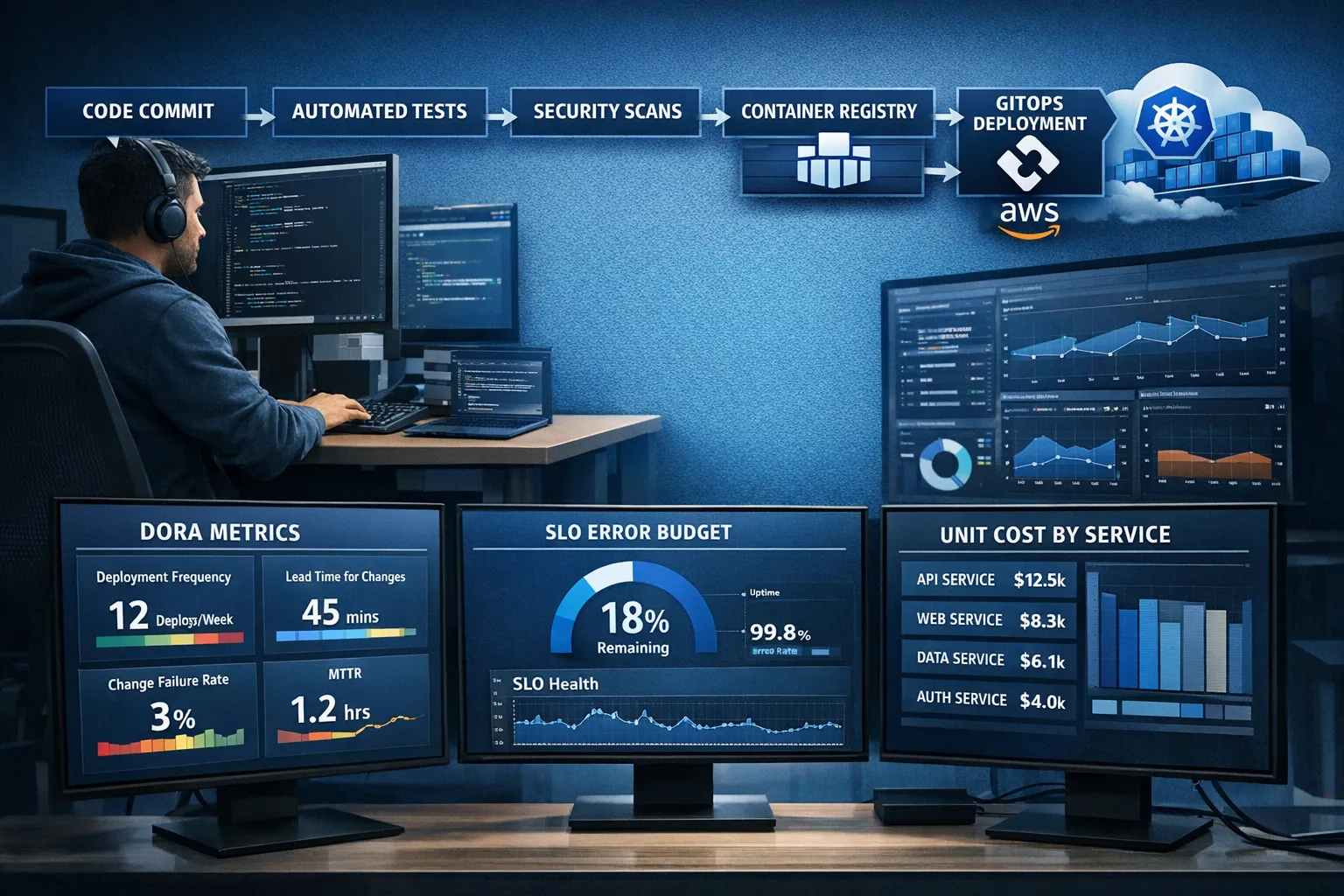
Cloud DevOps services integrate culture, automation, cloud architecture, and controls so teams can deliver quickly and safely. At Tasrie IT Services, this typically spans:
- DevOps consulting and delivery roadmaps
- Cloud native and Kubernetes platform engineering
- CI/CD pipeline automation and quality gates
- Infrastructure as Code with governance
- Cloud migration and managed operations
- Cybersecurity and DevSecOps controls
- Business process automation
- Monitoring, observability, and SRE practices
- AWS managed services and cost optimisation
- Data analytics and real-time pipelines
The outcomes are consistent across sectors, shorter lead times, higher deployment frequency, fewer failed changes, faster recovery, lower cloud spend, and stronger security posture.
Capabilities mapped to measurable outcomes
Modern engineering leaders manage by data. The table below shows how key capabilities translate into the metrics boards and CFOs care about.
| Capability | What we implement | Outcome to measure |
|---|---|---|
| CI/CD pipelines | Pipeline as code, trunk-based workflows, automated tests, security scans, blue green or canary releases | Lead time to change, deployment frequency, change failure rate |
| Kubernetes platforms | Managed Kubernetes such as AWS EKS with autoscaling including KEDA, GitOps with ArgoCD, multi-environment promotion | Reliability SLOs, time to provision environments, cluster utilisation |
| Observability and SRE | Prometheus and Grafana or Datadog, SLOs with alerting to Slack or PagerDuty, runbooks and incident workflows | MTTR, error budget burn rate, on-call noise reduction |
| Infrastructure as Code | Terraform modules, secure backends and state locking, drift detection, code review and policy as code | Time to provision, auditability, change approval lead time |
| Security in the SDLC | Static and dependency scanning, SBOMs, secrets management, hardened baselines, WAF and identity controls | Vulnerability backlog trend, time to patch, policy compliance rate |
| FinOps and cost control | Cost visibility and tagging, rightsizing, spot mix where safe, storage class tuning and pricing commitments | Cloud cost per service, savings realised, forecast accuracy |
| Data and analytics | Real-time ingestion, orchestration, and processing with battle-tested open source and cloud services | Time to insight, data freshness, pipeline success rate |
| Business process automation | API-first automation to replace brittle UI bots, centralised logic and audit trails | Cycle time reduction, failure rate, licence cost avoided |
Tools are selected to fit your stack and compliance needs, open standards first, with managed cloud services where they reduce operational risk.
Results you can benchmark against
Independent of industry, disciplined Cloud DevOps programmes deliver measurable gains. Recent Tasrie outcomes include:
- 30 percent reduction in an AWS EKS monthly bill by combining spot instances with resilient Pod disruption controls, see the EKS cost reduction case study.
- About USD 100,000 saved over three years by replacing an unnecessary enterprise API gateway during a Prometheus rollout, achieved with a careful canary plan, see the API gateway cost optimisation story.
- Stabilised, scalable CRM on AWS with EKS, HPA, Cluster Autoscaler, ArgoCD, and real-time monitoring, see Chalet International Properties on AWS.
- Event-driven autoscaling with KEDA for a UK healthcare provider that improved performance during peaks and reduced manual ops, see Healthcare autoscaling with KEDA.
- USD 40,000 annual saving by replacing fragile UI-based RPA with an API-first integration for SAP SuccessFactors, see SuccessFactors API automation.
These results come from applying fundamentals well, clear success criteria, fast feedback, safe change, and cost discipline.
A pragmatic 90 day approach that accelerates delivery and reduces risk
A successful Cloud DevOps engagement must produce value early while laying durable foundations. Here is a proven three-phase plan.
Days 0 to 30, baseline and quick wins
- Run a concise DevOps Strategy and Assessment to baseline maturity across people, process, platform, and governance, prioritise by business impact rather than tool preference.
- Establish core metrics, DORA measures, high level SLOs, and a cost visibility baseline with tagging standards and budgets.
- Eliminate top risks quickly, secret scanning on repos, confirm backup and restore of critical systems, patch high severity vulnerabilities, and implement multi factor access where missing.
- Deliver a first working pipeline and a production-like staging environment so teams can ship safely without waiting for a platform big bang.
Days 31 to 60, platform foundation and guardrails
- Codify infrastructure with Terraform, create secure cloud landing zones, and standardise environment creation.
- Stand up managed Kubernetes where appropriate, add GitOps for declarative promotion, and container registry with signing.
- Implement an observability starter pack, metrics, logs, traces, golden dashboards, SLOs with actionable alerts.
- Integrate security into the delivery flow, dependency and container scanning, SBOMs, policy as code on infrastructure and cluster admission.
Days 61 to 90, scale delivery and prove reliability
- Expand test automation, add controlled release strategies such as canary or blue green, and remove manual handoffs.
- Introduce incident management rituals and runbooks, game days to validate failure paths, and automated recovery checks.
- Execute the first wave of FinOps actions, rightsizing and storage class moves, and agree a savings plan or reserved capacity strategy backed by usage data.
- Formalise knowledge transfer and enablement, workshops and playbooks, so the improvements persist beyond the engagement.
By day 90 you should be deploying multiple times per week with confidence, have transparent cost and reliability data, and a roadmap to expand.
Risk reduction by design
Speed is only valuable when it is safe. The following practices reduce operational and security risk while increasing throughput.
- Safe change delivery, use short-lived branches and small pull requests with automated checks, deploy with canary or blue green patterns, and hold a fast rollback path.
- Secure supply chain, manage dependencies with SCA, generate SBOMs, verify signatures, and restrict what reaches production through policy as code.
- Identity-first security, centralised identity and strong MFA, least privilege IAM, and well-defined break-glass procedures.
- Defence in depth on the platform, hardened base images, namespace isolation, network policies, secrets management, WAF and DDoS controls at the edge.
- Design for failure, capacity safeguards, horizontal autoscaling, PDBs, multi AZ data stores where required, and tested backups with clear RTO and RPO.
- Full-stack observability, instrument services for metrics, logs, and traces, make alerts actionable, and connect them to incident workflows.
These controls bring auditability and resilience without slowing teams down.
FinOps built in, not bolted on
Cloud cost is a product metric, not just a finance line. Our approach is to expose unit economics, then continuously optimise.
- Visibility, normalise tags and cost allocation, dashboards for per service spend, budgets and alerts.
- Quick wins, power scheduling, storage tiering, instance and database rightsizing, spot where safe, gp3 upgrades on EBS, targeted cleanup.
- Structural improvements, pricing commitments such as Savings Plans after usage is stable, architecture changes that remove waste, and data transfer reduction.
For a deeper view of cost practices and a practical 90 day plan, see our guide to AWS cloud cost optimisation.
Developer productivity without drama
High performing teams invest in developer experience to remove friction, then protect flow with good defaults.
- Golden paths, paved templates for services and pipelines with security, tests, and observability embedded.
- Fast feedback loops, parallelised builds, smart caching, and pre-production environments that mirror production closely.
- Self service with guardrails, enable platform self service for common tasks via GitOps and IaC, approvals and policy applied automatically rather than through ticket queues.
The result is fewer handoffs, more autonomy, and better quality.
How to evaluate a Cloud DevOps partner
Selecting a partner is a risk decision. Look for signals that they will improve outcomes, not add complexity.
- Outcomes over tools, proposals should target DORA metrics, SLOs, and cost results, not just tool lists.
- Senior engineering depth, ask who will do the work, request example designs and runbooks.
- Open standards, preference for GitOps, Terraform, Kubernetes, and portable patterns to avoid lock in.
- Security and compliance credibility, verified practices and certifications, Tasrie is ISO 27001 certified which demonstrates a mature ISMS.
- Measurable 30 to 90 day plan, clear quick wins, and a path to production value within a quarter.
- Knowledge transfer, workshops and documentation included, so your teams can operate confidently.
Why Tasrie IT Services
Tasrie IT Services is a specialist in DevOps, cloud native platforms, automation, and data engineering. We emphasise measurable outcomes and senior hands-on expertise.
- Proven delivery across industries, healthcare, finance, real estate, retail, travel, and technology, with case studies showing improved reliability, faster delivery, and significant cost savings.
- Security you can trust, our ISO 27001 certification reflects robust information security practices embedded into our work.
- Recognised quality, Tasrie was named a Clutch Global Leader for Cloud Consulting based on client outcomes and reviews.
- Open, pragmatic approach, we prefer open standards, adopt managed services where they reduce risk, and build platforms your teams can own.
If you are ready to accelerate delivery and reduce risk, start small, pick a service or product line, build the first slice of platform and pipeline, and measure the change. Then scale with confidence.
Speak with Tasrie IT Services about Cloud DevOps services that move the needle on delivery speed, reliability, security, and cost. We will meet you where you are, define clear targets, and deliver results you can measure in weeks, not quarters.