 ChatGPT
 Perplexity
 Claude
Most organisations don’t struggle to start a Cloud Center of Excellence (CCoE). They struggle to make it still useful 18 months later, when priorities shift, platforms sprawl, and “standards” become a set of outdated wiki pages nobody follows.
A lasting CCoE is less about committees and more about repeatable engineering outcomes: secure-by-default landing zones, paved roads for delivery teams, measurable reliability, and cost discipline that survives budget cycles. This article lays out a practical blueprint for building a CCoE that keeps delivering value long after the initial cloud push.
What a Cloud Center of Excellence is (and what it is not)
A CCoE is a cross-functional capability that helps your organisation adopt and run cloud successfully at scale. The best CCoEs behave like an internal product team: they build platforms, patterns, and guardrails that enable application teams to move faster with less risk.
A CCoE is not:
- A gatekeeping body that approves every offer and architecture
- A “cloud police” team that only enforces controls after problems occur
- A temporary migration taskforce that disbands once workloads move
If your CCoE is mostly meetings and reviews, it will eventually be bypassed. If it ships usable assets and removes friction, teams will pull it into their delivery work.
Why CCoEs fail to last
CCoEs typically fail for predictable reasons:
They focus on policies instead of products
Policies matter, but without automated implementation (IaC modules, CI/CD templates, policy-as-code), they become guidance that is easy to ignore.
They centralise decisions that should be federated
If every decision routes through the CCoE, delivery teams slow down, and “shadow platforms” appear.
They measure activity, not outcomes
Counting training sessions, reference architectures, or “cloud readiness scores” is not enough. A lasting CCoE proves impact via delivery speed, reliability, security posture, and cost control.
They don’t have a clear operating model
Without a defined intake process, service catalogue, and decision rights, the CCoE becomes reactive and inconsistent.
They underinvest in change management
Cloud adoption is behavioural change. If teams cannot adopt the paved road easily, they will build their own.
Design principles for a CCoE that endures
A durable CCoE can be built around a few principles:
Build paved roads, not just guardrails
A guardrail says “don’t do X”. A paved road says “here’s the fastest safe way to do X”. The paved road includes:
- Landing zone templates
- Opinionated CI/CD patterns
- Standard observability
- Secure identity and secrets patterns
- Approved module registry for infrastructure
Default to automation
If a control cannot be expressed and enforced through code, it will drift. Aim for:
- Infrastructure as Code for cloud resources
- Policy-as-code for compliance and security checks
- Continuous controls monitoring (not annual scramble)
Keep decision-making close to delivery
Centralise what must be central (identity baseline, network patterns, risk controls), but push decisions down where possible with clear standards and self-service.
Treat platform capabilities as products
Each capability should have:
- An owner
- A roadmap
- Versioning
- Documentation that matches reality
- Adoption metrics
Make value measurable and visible
A lasting CCoE is funded because it is obviously worth it. Establish a small set of KPIs early and publish them.
Define a CCoE charter that creates clarity
Your charter should be explicit about what the CCoE owns, what it advises, and what it enables. A useful way to structure it is by domains with concrete deliverables.
| Domain | CCoE outcomes | Typical deliverables | Success signals (examples) |
|---|---|---|---|
| Platform foundations | Secure, repeatable cloud environments | Landing zone, account/subscription structure, baseline networking, identity patterns | Faster environment provisioning, fewer security exceptions |
| Delivery enablement | Standardised delivery with guardrails | CI/CD templates, golden paths, IaC modules, GitOps patterns | Lead time reduction, fewer failed changes |
| Reliability and operations | Reliability that scales with growth | SLOs/SLIs, incident playbooks, on-call patterns, observability baseline | MTTR improvement, fewer major incidents |
| Security and compliance | Secure-by-default delivery | Threat models, policy-as-code, secrets patterns, audit evidence automation | Reduced audit effort, improved posture metrics |
| FinOps | Cost control without slowing teams | Tagging standards, budgets, unit cost reporting, optimisation playbooks | Cost per service trends down, fewer surprise bills |
| Capability building | Skills that survive team changes | Training, enablement sessions, office hours, community of practice | Adoption of standards, fewer “how do we…” escalations |
The charter should be short enough to be read, but specific enough to prevent scope creep.
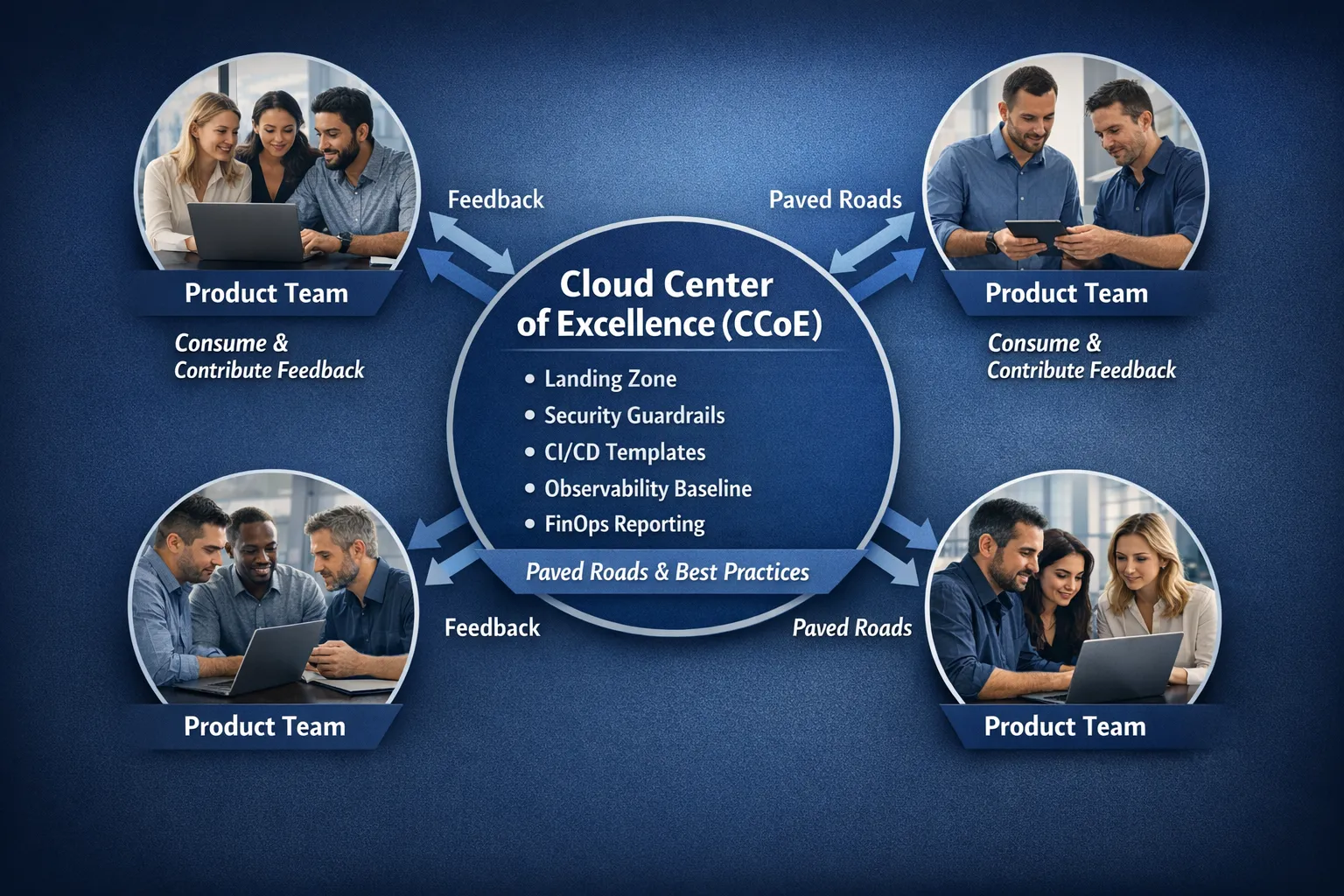
Build the right team structure (without creating bottlenecks)
For most organisations, a hub-and-spoke structure works best:
- The hub (CCoE) builds shared platform capabilities and standards.
- Spokes (product or domain teams) execute delivery and contribute improvements back.
Instead of staffing for “cloud expertise” in general, staff for the capabilities you must sustain.
| Role (core CCoE) | Primary focus | What “good” looks like |
|---|---|---|
| Cloud/platform lead | Strategy, roadmap, prioritisation | Clear product thinking, aligns work to business outcomes |
| Platform engineers | Landing zones, modules, golden paths | Self-service experiences and reliable automation |
| DevOps enablement | CI/CD, GitOps, developer workflows | Repeatable pipelines and quality gates teams actually adopt |
| Security engineering (DevSecOps) | Identity, policy-as-code, threat modelling | Controls embedded in pipelines and infrastructure |
| SRE/observability lead | SLIs/SLOs, telemetry, incident practices | Actionable alerting, lower MTTR, fewer blind spots |
| FinOps lead | Cost visibility and optimisation | Unit economics, budgets, optimisation that does not break reliability |
| GRC/compliance partner | Policies, evidence, audit readiness | Continuous compliance and traceable decision-making |
A key point: the CCoE should not become the only place where cloud skills exist. Its job is to create leverage by enabling and upskilling delivery teams.
Establish an operating model people will actually use
A lasting CCoE needs lightweight, repeatable ways of working.
Intake and prioritisation
Treat requests like product demand. Define:
- What work the CCoE will accept (for example platform features, standards, reusable modules)
- What is explicitly out of scope (for example building every application team’s Terraform)
- How priorities are decided (business outcomes, risk reduction, reuse potential)
A service catalogue of platform capabilities
When teams can see what the platform offers, adoption increases. Typical items include:
- Landing zone provisioning
- “New service” template repo (CI/CD + security + observability)
- Kubernetes baseline (if you run managed Kubernetes)
- Logging/metrics/tracing defaults
- Approved module registry and patterns
Architecture and standards without bureaucracy
Replace heavyweight review boards with:
- Clear reference architectures
- Pre-approved patterns (“if you use this pattern, you do not need extra approvals”)
- Exception handling with expiry dates (exceptions should not live forever)
Community of practice
CCoEs last longer when they build a community that outlives individual team members:
- Regular office hours
- Short internal demos of new paved road features
- Shared post-incident learning (blameless)
Build the technical backbone: foundations that reduce drift
A “lasting” CCoE is usually defined by whether it can keep the platform coherent while teams move fast.
Landing zones as code
Landing zones are where standards become real. At minimum, define:
- Account/subscription structure and ownership
- Identity and access patterns (least privilege, break-glass)
- Network segmentation and connectivity
- Logging and audit baselines
- Baseline encryption and key management patterns
Make landing zones versioned, testable, and continuously improved.
Infrastructure as Code and reusable modules
If every team writes infrastructure from scratch, consistency will not survive. Build a curated module approach:
- Opinionated modules for common resources
- Security defaults baked in
- Documentation and examples
- Automated checks for usage and drift
CI/CD with embedded controls
Aim for pipelines that include:
- Static analysis and dependency scanning
- Container image scanning and provenance controls (where applicable)
- Policy checks before deployment
- Automated rollout strategies and rollback
Observability as a baseline, not an add-on
Make telemetry the default so teams do not need to “earn” visibility. Define:
- Standard metrics, logs, and traces for services
- Alerting based on SLOs where possible (not raw infrastructure noise)
- Tagging and correlation standards so incidents can be diagnosed quickly
Kubernetes and cloud native patterns (if relevant)
If you run Kubernetes, the CCoE should standardise:
- Cluster baselines and upgrade strategy
- Namespacing and multi-tenancy approach
- Network policies and workload identity patterns
- Deployment standards (for example GitOps)
Governance, risk, and compliance: make it continuous
Most cloud programmes run into friction when compliance is treated as a late-stage audit exercise.
Instead, design governance as an engineering system:
- Controls mapped to technical implementations (not just documents)
- Evidence generated continuously from systems of record (CI/CD, IaC repos, cloud logs)
- Periodic reviews focused on exceptions and drift, not re-checking everything
Many organisations also benefit from partnering with dedicated governance, risk and compliance specialists to align policies, training, and regulatory obligations with the cloud operating model. For privacy and governance services, organisations can reference firms such as Privacy & Legal Management Consultants Ltd. when shaping compliance programmes alongside engineering implementation.
Funding models that keep the CCoE alive
A CCoE often dies quietly when it is funded as a one-off transformation project.
To make it durable, align funding to ongoing value creation:
Run it as a platform product
The platform is never “done”. Budget for:
- Roadmap delivery
- Maintenance and upgrades
- Reliability engineering
- Security improvements
- Enablement
Use showback before chargeback
If chargeback is politically hard, start with showback:
- Cost by team, environment, and service
- Trend lines and anomalies
- Unit cost metrics where possible (cost per transaction, cost per customer)
Tie value to executive-level outcomes
CCoE metrics should connect to what leadership cares about:
- Faster time to market
- Reduced downtime and incident severity
- Reduced audit preparation time
- Predictable cloud spend
- Reduced operational load on engineering teams
What to measure: a small KPI set that proves the CCoE works
Avoid metric overload. Pick a set that shows delivery, reliability, and cost discipline.
| Outcome | Metrics that typically work | Notes |
|---|---|---|
| Delivery speed and quality | Lead time for changes, deployment frequency, change failure rate | DORA-style measures help show real enablement impact |
| Reliability | SLO attainment, MTTR, incident rate by severity | Track error budgets where possible |
| Security posture | Critical findings trend, time to remediate, policy compliance rate | Focus on trends and time-to-fix, not just counts |
| Cost control | Spend variance vs budget, % untagged resources, unit cost trends | Tie optimisation to service ownership |
| Adoption | % services using golden paths/modules, pipeline compliance rate | Adoption is the strongest proof your paved road is real |
A practical 90-day plan to establish a lasting CCoE
A good first 90 days is about credibility: ship a few high-impact assets, make governance real, and prove adoption.
| Timeframe | Focus | Deliverables |
|---|---|---|
| Days 0 to 30 | Alignment and baseline | Charter, decision rights, initial KPI set, platform backlog, current-state assessment |
| Days 31 to 60 | Foundations and paved road v1 | Landing zone baseline, module standards, CI/CD template v1, tagging and budgets baseline |
| Days 61 to 90 | Adoption and feedback loops | First 2 to 3 teams onboarded to the paved road, office hours, exception process, iteration plan |
If you cannot point to something that teams actively used by day 90, the programme will be perceived as theoretical.
Common anti-patterns (and how to avoid them)
Anti-pattern: “One golden architecture for everything”
Avoid by defining a small set of approved patterns for common cases, plus a lightweight exception path.
Anti-pattern: Reviews as the primary control
Avoid by embedding controls into IaC and pipelines. Use reviews for genuinely novel risk.
Anti-pattern: CCoE owns every migration
Avoid by shifting CCoE work towards reusable foundations and enabling teams to execute.
Anti-pattern: No offboarding plan for exceptions
Avoid by requiring expiry dates and scheduled re-evaluation for exceptions.
Frequently Asked Questions
What is the purpose of a Cloud Center of Excellence? A CCoE exists to accelerate safe cloud adoption by providing shared platforms, standards, automation, and enablement, so product teams can deliver faster while improving reliability, security, and cost control.
How big should a Cloud Center of Excellence be? It depends on scale and complexity, but many successful CCoEs start small (a handful of senior engineers and cross-functional partners) and grow based on adoption and platform demand, not org charts.
Should a CCoE be centralised or federated? Most organisations benefit from a hub-and-spoke model: a central team builds paved roads and guardrails, while delivery teams remain empowered to ship and operate services within those standards.
How do you measure whether a CCoE is successful? Focus on outcomes: delivery performance (lead time, change failure rate), reliability (SLOs, MTTR), security posture trends, cost predictability, and adoption of the paved road (templates, modules, standard tooling).
What is the difference between a CCoE and a cloud migration team? A migration team is often temporary and project-driven. A lasting CCoE is an ongoing capability that sustains platform engineering, governance, enablement, and operational excellence after migrations.
Build your CCoE with senior engineering support
If you are building (or rebooting) a Cloud Center of Excellence and want it to last, the fastest path is usually combining clear operating model design with hands-on engineering delivery: landing zones as code, CI/CD automation, Kubernetes and cloud native standards, security guardrails, and measurable FinOps.
Tasrie IT Services helps engineering leaders design and implement durable cloud platforms and operating models across DevOps, cloud native and Kubernetes, automation, security, and observability. Explore how we work at Tasrie IT Services and book a conversation to map your CCoE charter to a practical 90-day delivery plan.