 ChatGPT
 Perplexity
 Claude
Most engineering leaders have had the same uncomfortable moment: your cloud bill is rising, production incidents are stealing roadmap time, and the team is debating whether to “just hire one more engineer” or bring in managed cloud services.
The choice is rarely as simple as cheaper vs more expensive. It is a trade-off between total cost of ownership (TCO) and how you define control: control as in “we touch every knob”, or control as in “we reliably hit SLOs, ship changes safely, and can explain spend by product”.
This guide breaks down Managed Cloud Services vs DIY with a practical lens: where the costs really come from, what control you keep (and what you give up), and how to decide based on your team size, risk profile, and growth stage.
What “Managed Cloud Services” actually means (and why definitions matter)
A DIY cloud setup can mean anything from “a few Terraform files and best-effort on-call” to a fully staffed platform team with FinOps, SRE practices, and strong security governance.
Likewise, managed cloud services vary widely. At a minimum, a mature provider typically covers some combination of:
- Cloud operations (monitoring, alerting, incident response, patching)
- Infrastructure as Code (IaC) hygiene and change control
- Cost management (allocation, optimisation, anomaly detection)
- Security hardening and continuous controls
- Backup/DR validation and routine resilience testing
- Support for CI/CD and cloud-native platforms (often Kubernetes)
Where teams get burned is comparing DIY to “managed” without aligning on:
- Scope (what systems are included)
- Service levels (response times, coverage hours)
- Shared responsibility (what you own vs what the provider owns)
- Change model (who can push changes, how approvals work)
If you have not explicitly defined these, you are not comparing options, you are comparing assumptions.
Cost: the hidden TCO gap between DIY and managed services
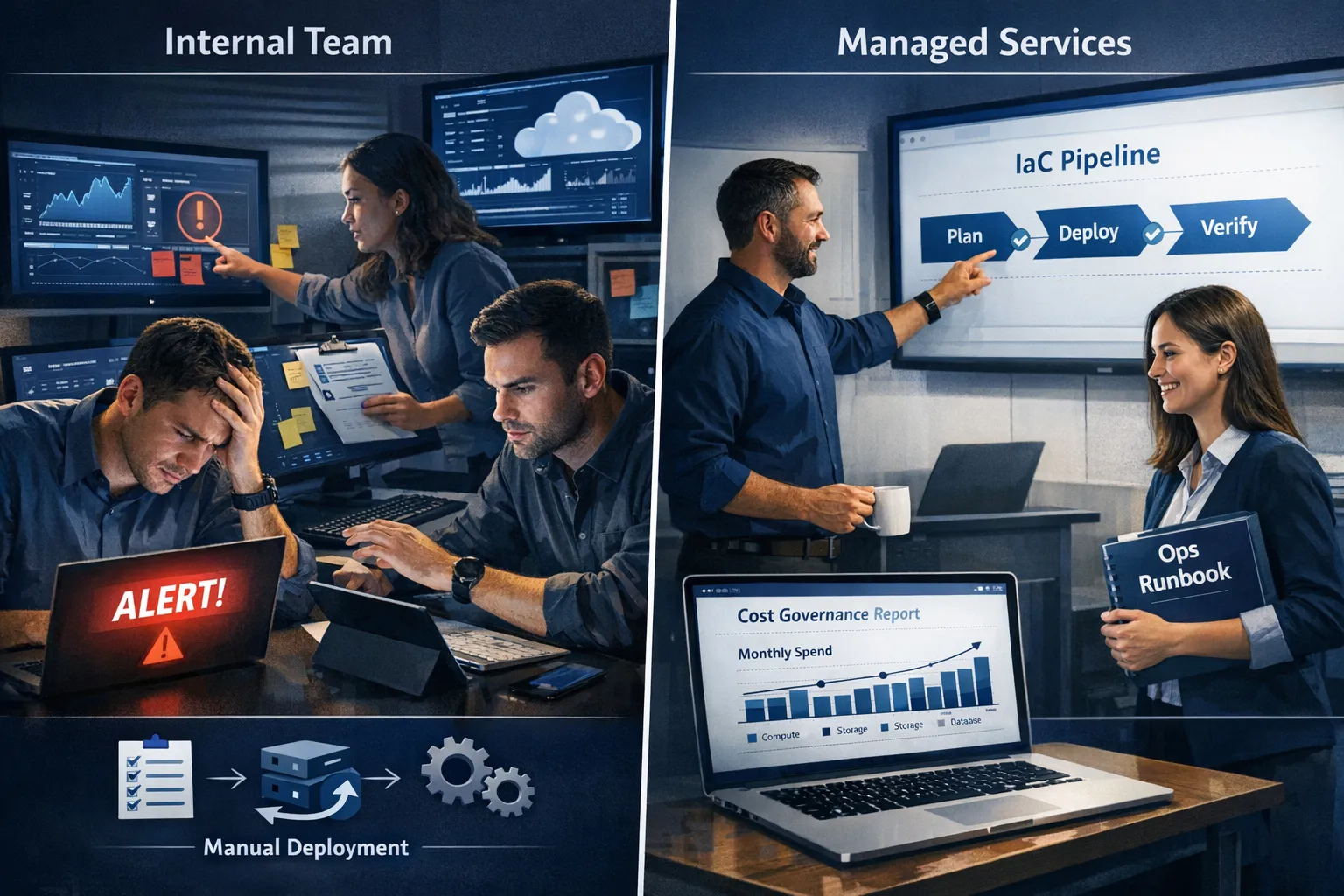
DIY often looks cheaper on paper because the cloud bill is visible, while engineering time, incident cost, and opportunity cost are not.
A useful way to structure the cost conversation is to split it into direct costs and hidden costs.
The direct costs are only the start
Direct costs are usually easy to list:
- Cloud infrastructure spend (compute, storage, managed services)
- Tooling (observability, security scanning, CI/CD tooling)
- Labour (platform engineers, SRE, security, on-call)
The challenge is that DIY operations tend to create hidden costs that do not show up in the first budget conversation.
The hidden costs most DIY teams underestimate
Hidden costs are the ones that turn “we have control” into “we are constantly reacting”:
- Interrupt-driven engineering: roadmap work slows because the same senior people repeatedly context-switch into incidents and cloud firefighting.
- Operational debt: quick fixes accumulate (handmade IAM policies, manual cluster upgrades, snowflake networking).
- Reliability tax: without disciplined SLOs, runbooks, and alert quality, on-call becomes noisy and expensive.
- Security and compliance drag: evidence collection, access reviews, vulnerability remediation, and audit trails become last-minute projects.
For many teams, the biggest “cost” of DIY is not the cloud bill. It is the portion of your best engineers’ time that quietly becomes operations.
A practical comparison table: where the money goes
| Cost area | DIY model (typical reality) | Managed cloud services model (typical reality) |
|---|---|---|
| Staffing | You hire for peaks, outages, and specialist gaps | You buy coverage and specialist depth as a service |
| Tool sprawl | Tools grow organically, overlapping capabilities | Tools are consolidated, standardised, and governed |
| Incident handling | Ad hoc escalation, tribal knowledge, inconsistent postmortems | Defined on-call, runbooks, post-incident improvements as part of service |
| Security work | Periodic and reactive (often driven by audits or incidents) | Continuous hardening, patching cadence, and controls monitoring |
| Cost optimisation | Reactive (after bill shock) | Continuous FinOps rhythm (allocation, waste removal, unit economics) |
| Change management | Fast until it breaks, then freezes | Safer changes through IaC, peer review, and controlled rollout |
The point is not that managed services are always cheaper. The point is that DIY costs are usually undercounted.
Control: what you keep, what you delegate, and what “good control” looks like
Many leaders equate DIY with control because they can edit everything themselves. In practice, control that is not operationally sustainable becomes fragile.
A better definition of control is:
- You can ship changes safely and predictably.
- You have clear ownership and escalation paths.
- You can explain spend and performance by product.
- You can meet security and compliance expectations.
Managed services do not have to remove control. They should convert control from “heroics” into a repeatable operating model.
The shared responsibility model is your baseline
Cloud providers already operate on a shared responsibility model, where the provider secures the underlying cloud and you secure what you build on top of it.
It is worth aligning your internal model to this same pattern. AWS explains the concept clearly in its documentation on the shared responsibility model.
With a managed services partner, you are effectively adding an additional “shared layer”: you still own business logic and critical decisions, while delegating execution and operational consistency.
A simple RACI-style view of control
| Domain | DIY: who does the work | Managed services: who does the work | What you should still control |
|---|---|---|---|
| Cloud architecture standards | Your team | Shared (you approve, provider implements) | Reference architecture, risk posture, platform principles |
| IaC and change control | Your team | Provider-led or co-managed | Approval gates, review requirements, rollout strategy |
| Monitoring and alerting | Your team | Provider-led | What “good” looks like (SLOs, user journeys, escalation rules) |
| Incident response | Your on-call | Shared with provider | Severity definitions, comms ownership, decision authority |
| Security baseline | Often fragmented | Provider-led with your security input | Policy decisions, exceptions, risk acceptance |
| FinOps | Usually part-time | Provider-led with reporting | Budget targets, chargeback/showback model, unit metrics |
If your provider cannot articulate this clearly, you do not have “managed services”. You have outsourced ambiguity.
The real decision: which model fits your organisation today?
The best choice depends on maturity, risk, and whether cloud operations is a differentiator for your business.
DIY tends to win when
DIY can be the right answer if most of the following are true:
- Your cloud footprint is small and relatively static.
- You already have senior platform/SRE capability in-house.
- Reliability and compliance requirements are modest.
- You can sustain on-call without burning out key staff.
- You need deep customisation that would slow down under a provider model.
DIY is not “wrong”. It is just expensive to do well, and risky to do halfway.
Managed cloud services tend to win when
Managed services become compelling when the business needs outcomes that outpace team capacity:
- You are scaling traffic, teams, or environments quickly.
- Cloud cost is rising faster than your ability to govern it.
- You have repeated incidents tied to operational gaps (monitoring, backups, patching, runbooks).
- You operate in a regulated environment or face customer security reviews.
- Your product engineers are spending too much time on platform toil.
An easy way to sanity-check the decision is to look at your operational work and ask: Is this a core product advantage, or a necessary capability that should be industrialised?
Cost modelling: how to compare DIY vs managed services fairly
If you want a comparison your CFO and engineering leads will both respect, build a lightweight TCO model. You do not need perfect numbers, you need honest categories.
A pragmatic TCO template
Consider tracking these line items for each option:
| Category | What to include | Why it matters |
|---|---|---|
| People (baseline) | Salaries for platform, SRE, security engineering time allocated to ops | Usually the largest cost driver |
| People (on-call and incidents) | On-call load, context switching, postmortems, weekend work | High variance, high burnout risk |
| Tools | Observability, SIEM, vulnerability scanning, CI/CD tooling, IaC workflows | DIY often duplicates tools over time |
| Cloud waste | Idle environments, overprovisioning, storage sprawl, data egress surprises | Waste is common without governance |
| Risk cost (expected) | Probability-weighted cost of major incidents and security events | Brings reality into the model |
| Opportunity cost | Delayed roadmap, slower delivery, lost revenue from downtime | Often the biggest strategic impact |
Even if you estimate roughly, you will usually find the “DIY is cheaper” story only holds when:
- your ops workload is low, or
- your team is already staffed and experienced, or
- you are comfortable accepting higher operational risk.
Control without chaos: what to demand from a managed provider
If the main objection is “we will lose control”, the fix is not to go DIY. The fix is to insist on transparent operations.
A strong managed services engagement should give you:
- Visibility: agreed dashboards, alerting rules, and regular reporting
- Traceable change: infrastructure and platform changes via IaC and review
- Operational rhythm: incident reviews, reliability improvements, cost reviews
- Clear escalation: who is on-call, how severity is defined, how you are notified
- An exit plan: documentation, IaC repositories, access management, handover process
In other industries, we accept this model without controversy. If your garage door breaks, you want a specialist to fix it quickly, but you still want clear pricing and predictable service. That is why many homeowners look for proven residential garage door specialists instead of improvising repairs, especially when safety and reliability matter.
Cloud is the same pattern, just with higher business impact.
The hybrid option: keep strategic control, outsource the heavy lifting
For many mid-market teams, the best answer is not “fully managed” or “fully DIY”. It is co-managed:
- Your team owns architecture decisions, risk acceptance, and product priorities.
- The provider owns operational execution, automation, reliability practice, and continuous improvement.
This hybrid model works especially well if you want to build internal capability over time, without taking on the full operational burden immediately.
Where Tasrie IT Services fits (and how to evaluate any partner)
Tasrie IT Services focuses on DevOps, cloud native platforms, automation, and measurable operational outcomes, including ongoing operations support. If you are comparing managed cloud services vs DIY, the most productive first step is usually not a long sales cycle, it is a short discovery that produces:
- a clear scope of what would be managed
- an operating model (responsibilities, change control, on-call)
- a baseline of reliability, security, and cost risks
- a prioritised roadmap of quick wins vs structural fixes
If you decide to work with any provider, look for senior engineering involvement, evidence-driven reporting, and security alignment. (Tasrie IT Services has publicly shared its ISO 27001 certification, which is often relevant if you need a partner with formal information security management practices.)
Key takeaway
DIY gives you maximum hands-on control, but you pay for it in senior engineering time, operational risk, and slower delivery unless you invest heavily in platform maturity.
Managed cloud services can reduce that operational burden, but only deliver real value when responsibilities are explicit, changes are traceable, and outcomes (SLOs, cost, security) are measured.
If you want, share your current setup (cloud provider, team size, whether you run Kubernetes, and your biggest pain point: cost, incidents, compliance, or delivery speed). I can suggest a realistic DIY vs managed split and what to include in scope so the comparison is apples-to-apples.