 ChatGPT
 Perplexity
 Claude
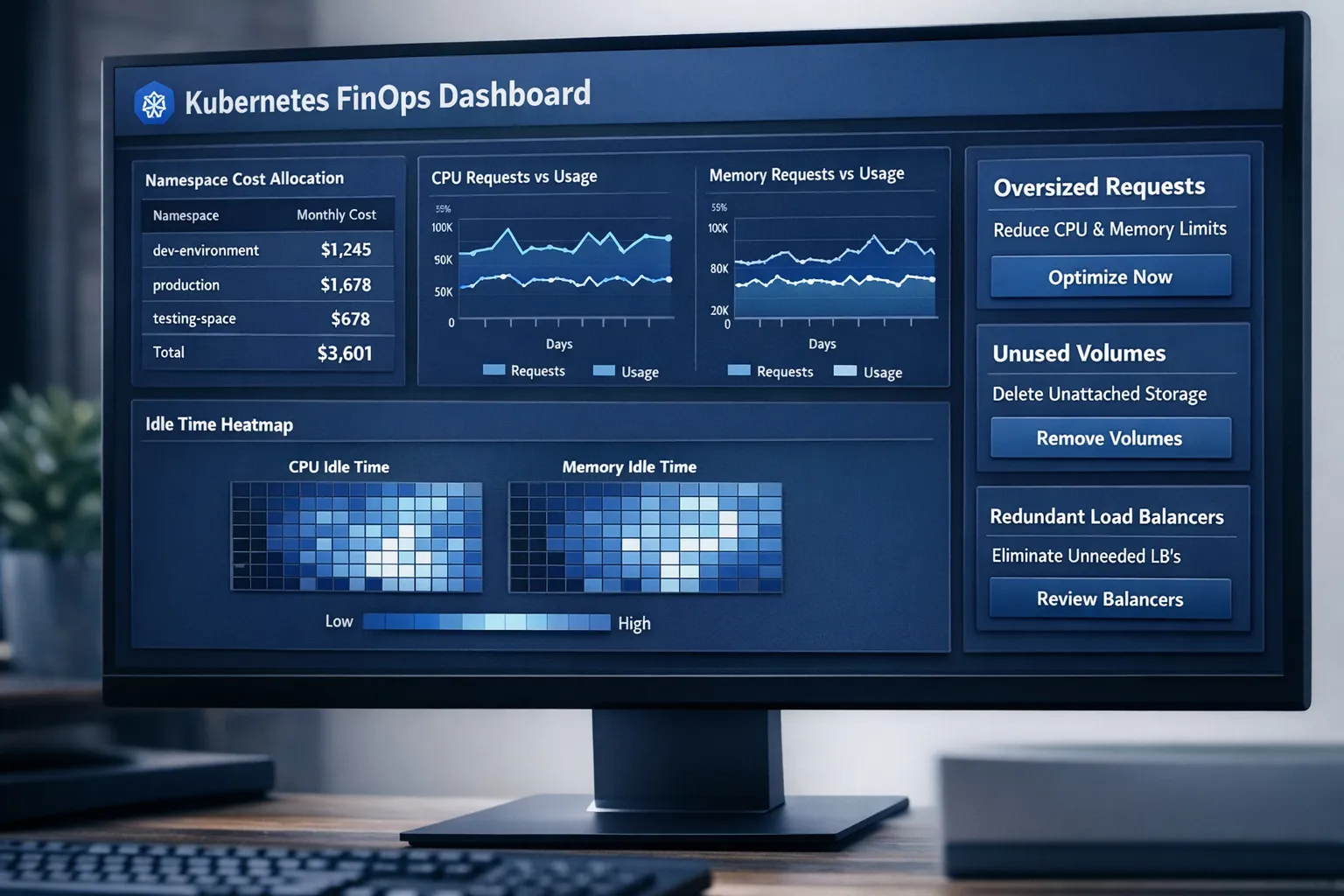
Kubernetes can be the fastest way to scale engineering, and the fastest way to inflate your cloud bill. The good news is that most clusters hide 20 to 40 percent in avoidable waste through over‑requests, idle non‑prod, redundant load balancers, storage sprawl, and high‑cardinality telemetry. This playbook shows you how to cut cluster costs fast, then keep them down with FinOps discipline.
Why Kubernetes costs feel opaque
Kubernetes turns infrastructure into a shared, dynamic pool. That flexibility complicates unit economics and chargeback. Costs cross many layers that are easy to overlook:
- Compute, nodes and instance families, on demand versus spot
- Scheduling, bin packing, requests and limits, PDBs and topology spread
- Storage, volume classes, snapshots, orphaned PVCs, logging retention
- Networking, cross‑AZ traffic, egress, load balancers and ingress sprawl
- Observability, metrics and log cardinality, retention windows, APM sampling
A Kubernetes FinOps approach aligns engineering and finance using the FinOps Foundation phases, Inform, Optimise, Operate, applied to clusters. Start with visibility, apply targeted technical levers, then build lightweight governance so savings persist.
The 48‑hour quick wins
If you do nothing else this week, do these. They are safe, fast and usually deliver immediate savings without changing application code.
- Turn on accurate cost visibility
- Deploy OpenCost or Kubecost for per‑namespace, per‑workload allocation that maps to teams and products. The FinOps Framework recommends showback as the first step to drive behaviour change.
- Standardise Kubernetes labels for cost allocation, for example app, team, owner, env, cost-centre.
- Right‑size the worst offenders
- Identify pods with requests far above actual usage. A quick signal is the ratio of requests to median usage from Prometheus or kubectl top.
- Use a right‑sizing assistant, for example Goldilocks, to propose request values. Remove CPU limits for latency‑sensitive services to avoid throttling if you can tolerate occasional burst.
- Autoscale to zero when idle
- Non‑production, schedule‑driven workloads and cron jobs should not keep nodes warm all night.
- Add time‑based downscaling for dev and staging, and consider an over‑provisioner to speed up scale‑out during office hours.
- Consolidate load balancers
- Replace per‑service external load balancers with a single ingress where appropriate. We have a full walk‑through here, Expose Multiple Apps with one LoadBalancer in Kubernetes.
- Tame storage and telemetry
- Switch gp2 to gp3 on AWS, keep IOPS and throughput explicit. Clean up unused PVCs and old snapshots.
- Reduce Prometheus retention to a sensible window and drop high‑cardinality labels that do not drive action.
Quick example to drop noisy labels in Prometheus scrape configs:
metric_relabel_configs:
  - source_labels: [pod]
    regex: ^prometheus-.+
    action: drop
  - source_labels: [status_code]
    regex: 1..|3..
action: drop- Let the cluster scale down
- Ensure Cluster Autoscaler is enabled and allowed to drain nodes aggressively during low traffic. Verify Pod Disruption Budgets do not block scale‑in.
For a real‑world proof point, see how we delivered a 30 percent EKS cost reduction with spot and scheduling improvements.
Two to four weeks, structural savings
These changes deliver durable savings and better price performance.
- Adopt spot capacity safely. Run a mixed pool of on demand for baseline and spot for burst. Add PDBs, topology spread constraints, and interruption handling. Alert on spot evictions.
- Bin pack workloads deliberately. Separate node groups by workload profile, for example CPU‑heavy, memory‑heavy, GPU, system. Use affinity and taints to keep system daemons off application nodes.
- Modernise node families. On AWS, test Graviton for better price‑performance. Keep AMIs lean and consistent.
- Use Karpenter or Node Autoprovisioning. Let the provisioner pick the best‑fitting instance size at runtime to reduce bin‑packing waste.
- Rightsize persistent volumes. Avoid over‑provisioned storage classes, compress and tier off cold data, consider object storage for logs and artefacts instead of block volumes.
- Keep HPA and VPA in their lanes. Use HPA for spiky, stateless services and VPA in recommend mode for steady right‑sizing. Avoid running both in control mode on the same target.
- Streamline observability. Sample traces, set log sampling or dynamic log levels in non‑critical paths, and negotiate retention based on recovery and audit needs, not defaults.
- Eliminate paid features you no longer need. We often find legacy gateways or appliances retained out of habit. In one client engagement we replaced an enterprise API gateway with a Kubernetes‑native stack and saved around USD 100,000 over three years.
Operate with FinOps discipline
Once you have visibility and technical levers in place, light governance keeps costs flat while you scale.
- Create showback dashboards per team and application. Review monthly with engineering leads. Tie budgets to unit metrics, for example cost per 1,000 requests or cost per customer.
- Add policies that prevent waste from re‑appearing. Require requests and limits, prevent load balancers in non‑prod, enforce TTLs on ephemeral namespaces.
Example, Gatekeeper policy to force requests and limits on all containers:
apiVersion: constraints.gatekeeper.sh/v1beta1
kind: K8sRequiredLimits
metadata:
  name: containers-require-requests-limits
spec:
  match:
    kinds:
      - apiGroups: [""]
        kinds: ["Pod"]
  parameters:
    limits:
      - resource: cpu
      - resource: memory
    requests:
      - resource: cpu
- resource: memory- Budget for reliability. Keep a small on‑demand reserve even when you embrace spot. Validate PDBs and chaos test interruptions so cost savings do not create availability regressions.
- Align to open standards. The OpenCost spec makes multi‑cluster, multi‑cloud cost allocation comparable and auditable.
A healthy cost culture is like personal wellness, small habits compound. Many high‑performing teams adopt on‑demand support rituals outside of tech to stay sharp, for example hydration and recovery services such as mobile IV therapy in Austin. The engineering parallel is a standing, rapid response routine for cost spikes, so you can correct waste within hours, not quarters.
Cost levers at a glance
| Area | What to change | Tools and patterns | Effort | Speed to impact |
|---|---|---|---|---|
| Visibility | Per‑namespace allocation and showback | OpenCost or Kubecost, standard labels | Low | Fast |
| Compute | Spot mix, bin packing, right‑size requests | HPA, VPA recommend, Karpenter, Cluster Autoscaler | Medium | Fast |
| Networking | Consolidate LBs, reduce cross‑AZ traffic | Ingress, internal services, topology spread | Low | Fast |
| Storage | Tiering and retention, right‑size volumes | gp3, lifecycle policies, S3 for logs | Medium | Medium |
| Observability | Reduce cardinality and retention | Prometheus relabel, sampling, remote write | Low | Fast |
| Governance | Prevent waste, set budgets and unit costs | Gatekeeper or Kyverno, budgets, showback | Low | Medium |
Savings vary by workload and risk appetite. The most reliable reductions come from a safe spot strategy, right‑sizing, and turning off idle non‑prod.
A 30, 60, 90 day Kubernetes FinOps plan
Day 0 to 30, Inform and first savings
- Install OpenCost, standardise labels, and publish showback per team
- Right‑size top 10 over‑requested workloads and set HPA targets from real SLOs
- Enable Cluster Autoscaler and fix PDBs that block scale‑in
- Consolidate load balancers with ingress where appropriate
- Reduce Prometheus retention and drop noisy labels
Day 31 to 60, Optimise structure
- Introduce spot with safe disruption budgets and interruption handling
- Split node groups by workload profile, test Graviton where applicable
- Adopt Karpenter or equivalent to shrink bin‑packing waste
- Migrate large logs and artefacts to object storage with lifecycle rules
Day 61 to 90, Operate and govern
- Enforce policies for requests and limits, ingress in non‑prod, TTL on ephemeral namespaces
- Agree monthly budget and unit economics per service, and a showback cadence
- Run a game day to validate spot interruptions and scale‑in behaviour
Proof from the field
- Travel and hospitality, 30 percent EKS savings with a 70 percent spot mix, PDBs, and proactive alerts, no service disruption. Read the case study, 30 percent Cost Reduction in AWS EKS.
- Enterprise API gateway elimination during a Prometheus rollout saved around USD 100,000 over three years and simplified operations. Read, Replacing Enterprise API Gateway.
- We apply the same Measure, Optimise, Govern framework across cloud estates, see our guide, AWS Cloud Cost Optimisation.
Frequently asked questions
What is Kubernetes FinOps in a sentence? FinOps applied to Kubernetes means measuring costs per team and workload, then using platform engineering levers and light governance to keep spend aligned to business value.
How fast can we see savings? Most teams see measurable reductions within two weeks by right‑sizing, consolidating load balancers, and enabling scale‑down in non‑prod. Structural savings from spot and bin packing follow in the next two to four weeks.
Is spot safe for production? Yes, for the right workloads. Use PDBs, topology spread, fast rescheduling, and interruption handlers. Keep a baseline of on‑demand capacity for critical paths.
Do we need a commercial tool to start? No. OpenCost gives you vendor‑neutral allocation. Pair it with Prometheus and Grafana for visibility, then add commercial tools later if you need deeper analytics or forecasting.
What are the biggest hidden costs in Kubernetes? Idle non‑prod environments, over‑requested resources, high‑cardinality telemetry, redundant load balancers, and cross‑AZ data transfer are the usual suspects.
How do we keep savings from eroding over time? Add showback, a monthly review with engineering leads, and a few policy‑as‑code guards. Treat cost like reliability, a continuous practice, not a one‑off project.
Cut cluster costs fast with Tasrie IT Services
If you want concrete savings in weeks, not quarters, our senior engineers can deploy OpenCost, right‑size workloads, implement safe spot, and put policy guardrails in place. We have delivered double‑digit reductions repeatedly while improving reliability.
- DevOps consulting, Kubernetes and platform engineering, CI/CD automation
- Infrastructure as Code and AWS managed services
- Monitoring and observability with Prometheus, Grafana and OpenTelemetry
Start your Kubernetes FinOps programme today. Visit Tasrie IT Services at tasrieit.com to schedule a consultation.