ChatGPT
 Perplexity
 Claude
Kubernetes can unlock faster delivery and safer scaling, but it also introduces a different class of operational risk. Many teams only discover that after a few months of “it works on my cluster”, when an upgrade fails, a node pool drains at the wrong time, or cloud costs drift beyond what Finance signed off.
Bringing in Kubernetes experts is rarely about a lack of smart engineers. It’s usually about reducing execution risk at a critical moment, and making sure the platform becomes an accelerator instead of a tax on delivery.
Why “waiting it out” with Kubernetes often gets expensive
Kubernetes problems tend to compound because so many concerns are coupled:
- Reliability: capacity, autoscaling, disruption budgets, readiness probes, cluster add-ons, and safe rollouts all interact.
- Security: identities, network policies, secrets, supply chain, image scanning, admission control, and audit evidence need to line up.
- Cost: resource requests, node shape, storage class defaults, load balancers, logging cardinality, and non-prod sprawl can quietly inflate spend.
The CNCF annual surveys repeatedly show that organisations adopt Kubernetes for scale and portability, but complexity and security remain persistent challenges. In practice, that “complexity” usually shows up as time lost in incident response, slow platform changes, and uncertainty about what is safe to standardise.
The clearest signs it’s time to bring in Kubernetes experts
Not every Kubernetes initiative needs external help. But certain signals correlate strongly with avoidable outages, rework, and overspend.
| Signal you’re hitting a wall | What it looks like day-to-day | Risk if you keep pushing DIY | What Kubernetes experts typically do first |
|---|---|---|---|
| Production incidents are increasing | Paging is frequent, root causes are unclear, fixes are manual | MTTR stays high, incident fatigue, trust erosion | Tighten observability, improve rollout safety, standardise runbooks and SLO-based alerting |
| Costs are rising without a clear driver | “We scaled up, but why did the bill jump?” | Waste accumulates, budget confidence collapses | Implement allocation/visibility, rightsize requests, tune autoscaling and node strategy |
| You’re planning a migration (or it’s stalled) | A few services moved, the rest are blocked | Architecture drift, duplicated patterns, long cutover risk | Create a migration blueprint, define landing zone, pick a repeatable deployment pattern (often GitOps) |
| Upgrades are scary | You postpone Kubernetes version upgrades or add-on updates | Security exposure and fragile drift | Establish upgrade strategy, automate checks, remove brittle customisations |
| Networking and ingress are a constant source of tickets | DNS issues, timeouts, complex ingress rules | Latency, outages, hard-to-debug production behaviour | Standardise ingress and traffic management, harden network policies, simplify topology |
| Stateful workloads keep breaking | Storage, backups, failover or performance are unreliable | Data risk and operational uncertainty | Align CSI/storage classes, backup/restore, and DB runbooks with SLOs and RPO/RTO |
| Security/compliance pressure is rising | Audits demand evidence you can’t easily produce | Delayed releases, unplanned remediation work | Implement policy-as-code, workload hardening, audit trails and least-privilege access |
| Developers bypass the platform | Teams deploy “their own way” because the golden path is painful | Fragmentation and support burden | Design an internal platform experience with sane defaults and self-service |
| Multi-cluster or hybrid is becoming necessary | Teams request isolation, geo routing, DR, or multiple regions | Operational overhead spikes | Define multi-cluster strategy, shared services, GitOps and governance |
| You have a “hero operator” dependency | One person knows how the cluster works | Bus factor risk and slow change | Document, automate, train, and build operational ownership across the team |
If two or three of these are true, you’re not “bad at Kubernetes”. You’re in the zone where expertise pays for itself by preventing rework.
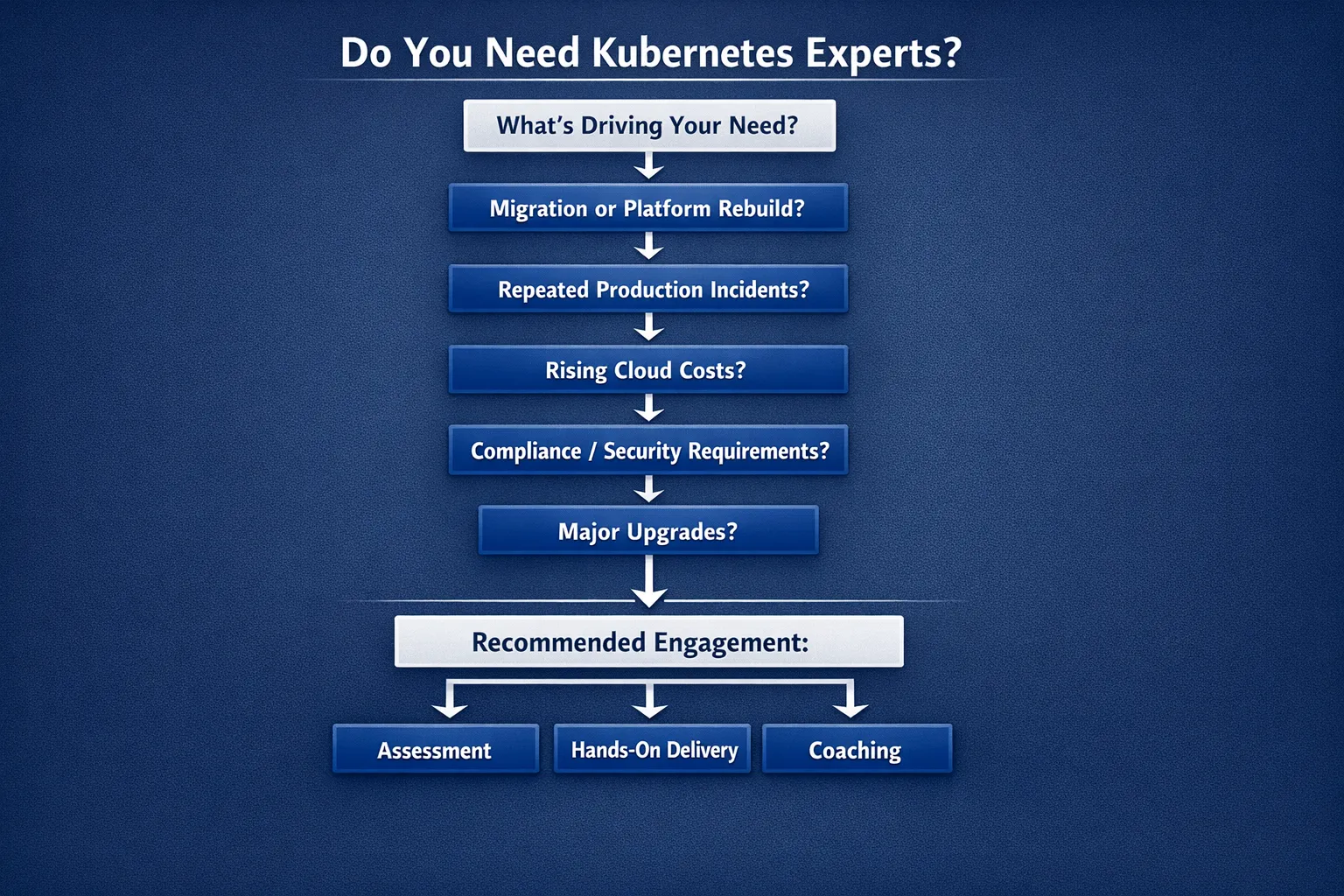
High-stakes moments where outside expertise is most valuable
1) Before a Kubernetes migration or major re-platform
The most expensive migration failures are rarely about YAML. They are about foundational decisions made too late:
- Cluster and network topology (single vs multi-cluster, VPC/VNet layout, ingress model)
- Identity and access patterns (workload identity, RBAC boundaries, admin access)
- Deployment model (GitOps vs imperative changes)
- Observability baseline (what you will measure on day one)
If you are migrating from VMs or ECS to Kubernetes, experts can help you avoid a “cluster first, strategy later” outcome and instead build a migration sequence that reduces cutover risk.
2) When you need a secure-by-default baseline (especially in regulated industries)
Security in Kubernetes is not a single tool. It is a chain:
- Image provenance and vulnerability management
- Admission control and policy enforcement
- Runtime hardening and least privilege
- Network segmentation
- Auditability (who changed what, when, and why)
For teams in finance, healthcare, or any environment with heavy customer/security scrutiny, an expert-led baseline can shorten audit cycles and reduce the volume of unplanned remediation.
If you want a strong reference point, the NIST guidance on container security is still widely cited, and maps well to what modern Kubernetes platforms must operationalise.
3) When Kubernetes is becoming a cost centre
Kubernetes spend problems are often invisible until they are large:
- Over-requested CPU/memory (low utilisation but high bills)
- Non-prod clusters running 24/7
- Too many load balancers, NAT gateways, or oversized storage
- Logging/metrics costs due to high-cardinality labels
At this stage, experts typically combine FinOps and platform changes: visibility, allocation, and guardrails, then structural optimisation (node strategy, autoscaling, spot/preemptible where appropriate).
If this is your main pain, you may also find our guide on Kubernetes FinOps useful as a starting point for internal alignment.
4) Before disruptive deadlines (ingress and traffic management changes)
In early 2026, many teams are reviewing ingress strategy because of ecosystem shifts. If you are impacted by NGINX Ingress retirement timelines, it can be safer to treat this as a controlled migration rather than a last-minute replacement.
A practical approach is to time-box a design review and migration plan (including testing and rollback), before touching production traffic. If relevant, see Tasrie IT’s guide on migrating from NGINX Ingress to Envoy Gateway.
What a good Kubernetes expert engagement should deliver (and what it shouldn’t)
A strong engagement is measurable, reduces risk, and leaves your team stronger. In most organisations, the first 2 to 4 weeks should produce concrete artefacts, not just advice.
Expected deliverables you can ask for
| Area | Concrete outputs that create lasting value |
|---|---|
| Architecture | Reference architecture, cluster topology decisions, and documented trade-offs |
| Delivery | A repeatable deployment pattern (often GitOps), environment promotion rules, rollback strategy |
| Security | RBAC model, baseline policies, secrets approach, evidence-friendly audit trail plan |
| Observability | SLIs/SLOs, alerting principles, dashboards for services and the platform |
| Operations | Runbooks, on-call readiness, incident workflow improvements, upgrade plan |
| Enablement | Training sessions, pairing, and a handover plan that reduces hero dependencies |
Red flags
- “We’ll install a tool and it will solve reliability.” Tools help, but reliability is a system of practices.
- Heavy custom platform work before agreeing on outcomes and operating model.
- No plan for handover, documentation, or training.
How to decide: coaching, hiring, or external experts?
You don’t always need a big consulting programme. A simple decision rule is to separate capability building from delivery risk.
Choose coaching (lightweight expert support) when
Your platform is mostly stable, but you need help with:
- Kubernetes best practices and internal standards
- Safer CI/CD and release patterns
- Upgrades, runbooks, and incident readiness
Choose hands-on delivery when
You have a deadline or high blast radius change, such as:
- A migration or major re-architecture
- A compliance/security baseline initiative
- A cost optimisation programme tied to board scrutiny
Choose hiring when
Kubernetes is core to your product and you need permanent ownership, but consider that senior platform engineers are hard to hire quickly. Many organisations use experts to stabilise and standardise first, then hire into a clearer operating model.
How to vet Kubernetes experts (questions that reveal real capability)
You don’t need to test for trivia. You need to test for judgement and operating experience.
Ask about failure modes, not just features
Good prompts:
- “What are the top three ways you’ve seen Kubernetes upgrades fail, and how do you de-risk them?”
- “How do you prevent configuration drift between environments?”
- “Which metrics do you use to decide whether autoscaling is actually helping?”
Ask how they measure outcomes
Look for answers tied to things your leadership cares about:
- Deployment frequency and change failure rate (DORA-style metrics)
- SLO compliance and MTTR
- Cost per environment or cost per unit (where unit is meaningful for your product)
The goal is not to chase vanity metrics, but to show that platform work is improving delivery and reliability.
Ask how they will leave you better off
The best engagements make themselves replaceable by delivering:
- Clear documentation and runbooks
- A training plan
- Automation and guardrails
- A roadmap with prioritised next steps
Budgeting and stakeholder confidence: the overlooked reason to hire experts
Kubernetes programmes often lose internal support when spend and timelines become unpredictable. One practical move is to treat the work like any other investment: define outcomes, set a time-boxed phase, and track costs against milestones.
Even a simple tracking approach can help founders and engineering leaders communicate clearly with Finance. For smaller organisations that don’t yet have formal tooling, a lightweight tracker like the MoneyPatrol budgeting dashboard can be a convenient way to keep project spend, subscriptions, and renewal dates visible while you stabilise your platform and put longer-term governance in place.
Bringing it together: a pragmatic way to engage Kubernetes experts
If you want to move fast without handing over the keys entirely, a common high-leverage model looks like this:
- Time-boxed assessment: validate architecture, security baseline, delivery workflow, and operational readiness.
- Prioritised remediation plan: focus on the few changes that remove the biggest risk first.
- Hands-on implementation plus pairing: experts deliver improvements while your team learns the patterns.
- Handover with proof: runbooks, upgrade plan, dashboards, and an agreed operating model.
This is also where an engineer-led consultancy like Tasrie IT Services fits well: the work stays grounded in practical delivery across DevOps, cloud infrastructure, Kubernetes, security, and observability, with a focus on measurable outcomes rather than tool-driven change.
If you’re unsure whether you need outside help, the fastest next step is usually a short diagnostic conversation focused on your current pain points (incidents, upgrades, migration, cost, or compliance) and what “success” must look like in the next 60 to 90 days.