 ChatGPT
 Perplexity
 Claude
Choosing a managed service provider is not a tooling decision, it is a strategic partnership choice that will shape how your teams ship software, manage risk, and control costs. With cloud native platforms, Kubernetes, CI/CD, data, and security in scope, the right MSP becomes a force multiplier. The wrong one creates lock‑in, opaque costs, and slow progress.
This practical guide shares a clear, testable way to select an MSP, grounded in what modern engineering organisations actually need in 2025.
Start with outcomes, not a feature list
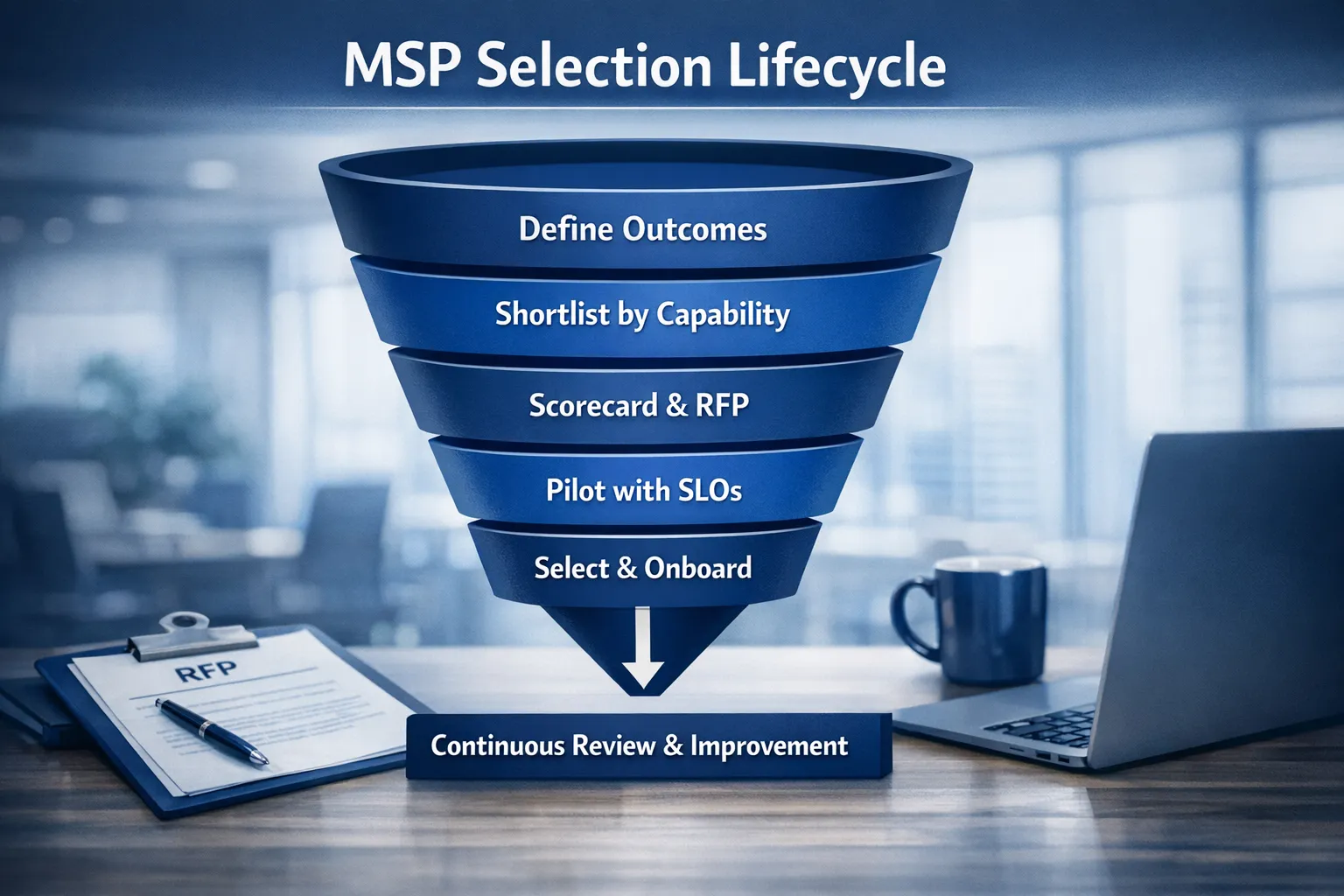
Before you write an RFP, define the business and engineering outcomes you expect over the next 12 to 24 months. Translate those outcomes into measurable service objectives so that every proposal can be assessed against the same criteria.
Examples of outcome‑driven goals:
- Improve deployment frequency and lead time without increasing change failure rates.
- Raise service reliability, with explicit SLOs for availability and latency.
- Reduce cloud spend while maintaining performance, through FinOps practices and automation.
- Strengthen security posture and compliance, evidenced through regular assessments and audit‑ready reporting.
These outcomes become your acceptance tests for any MSP relationship. If a provider cannot map their delivery approach and reporting to these goals, they are not the right fit.
What a modern MSP must be able to do
A credible managed service partner in 2025 should demonstrate maturity across these domains. Look for evidence in the form of reference architectures, runbooks, tooling, and client case studies.
Cloud native operations
Your provider should run and support Kubernetes and containerised workloads across AWS and other clouds, use Infrastructure as Code and Git‑centred workflows, and design for multi‑tenant isolation and security by default. They should be comfortable with managed Kubernetes services and have a clear stance on cluster lifecycle, upgrades, and add‑on management.
DevOps, CI/CD and platform engineering
Expect standardised pipelines, policy as code, automated testing and security scanning, and a platform engineering mindset that abstracts common services for product teams. The goal is paved roads rather than bespoke scripts.
Monitoring and observability
End‑to‑end telemetry is non‑negotiable. A strong provider will integrate logs, metrics, and traces, define service‑level indicators, and provide clear dashboards and weekly or monthly service reviews. If you are comparing approaches, our overview of observability fundamentals explains what good looks like.
Security and compliance
Look for ISO 27001 certification and a defensible security programme, including identity‑first access, secrets management, vulnerability management, and incident response playbooks. Providers should be comfortable aligning to regulations that affect your industry and geography.
FinOps and cost control
Costs should be measured and governed, not guessed. The provider should offer tagging strategies, budgets, rightsizing playbooks, savings recommendations, and reporting at least monthly. For background, see our AWS cost optimisation framework.
Data and analytics operations
If data platforms are in scope, the MSP should show how they operate analytics stacks securely and cost‑effectively, including event streams, warehouses, and visualisation tooling.
Business process automation
Beyond infrastructure, the best MSPs help automate repetitive operational and business workflows to accelerate value creation.
A simple, weighted scorecard for decisions
Use a transparent scorecard to compare providers apples to apples. Weights are examples, adjust to your priorities.
| Criterion | What good looks like | Suggested weight |
|---|---|---|
| Reliability and SRE | Documented SLOs, error budgets, on‑call processes, incident reviews | 20% |
| Security and compliance | ISO 27001 certification, secure SDLC, audit‑ready reporting | 15% |
| Cloud native and Kubernetes | Proven EKS and multi‑cluster experience, upgrade strategy, IaC | 15% |
| CI/CD and automation | Standardised pipelines, policy as code, automated testing | 10% |
| Observability and reporting | SLIs, dashboards, runbooks, executive and technical reports | 10% |
| FinOps and cost outcomes | Cost visibility, optimisation playbooks, unit economics | 10% |
| Talent and ways of working | Senior engineers, knowledge transfer, collaborative culture | 10% |
| Commercials and flexibility | Clear pricing, fair terms, exit plan and portability | 10% |
Total your results and keep notes that justify each score. Choose on demonstrated capability and fit, not presentation polish.

SLAs, SLOs and reporting, what good looks like
Service Level Agreements are contractual minimums. Service Level Objectives are the engineering targets your users experience. Ask providers to propose both and show the dashboards they will share.
Example metrics and indicative targets for a production web platform. Use these as a starting point and adapt to your risk profile.
| Metric | Example target | Notes |
|---|---|---|
| Uptime | 99.9 percent monthly | Scope and measurement method must be explicit |
| P1 response time | Under 15 minutes | Define what constitutes P1, P2, etc. |
| P1 resolution or workaround | Under 2 hours | Include escalation path |
| Change failure rate | Under 10 percent | Tracked via CI/CD and incidents |
| Mean time to recover | Under 60 minutes | Based on critical services |
| Cost variance vs budget | Under 10 percent | Monthly, per environment or team |
Require a clear taxonomy for incident severity, RCA templates, and a cadence for service reviews. Make sure any SLA credits are meaningful and realistic.
RFP questions that separate contenders from pretenders
Move beyond “what tools do you use” and ask scenario‑based questions. You want to test judgement, not brand recall.
Strategy and governance
- How do you translate business goals into SLOs and error budgets for services in scope?
- What is your approach to runbooks and change governance without slowing delivery?
Onboarding and transition
- Describe your first 90 days. What do you assess, stabilise, and automate first? What risks typically surface?
- How do you migrate existing infrastructure into Infrastructure as Code safely?
Operations and reliability
- Show an example of your incident command process and how you run post‑incident reviews.
- How do you handle Kubernetes version upgrades and add‑on lifecycle with zero or minimal downtime?
Security
- Provide evidence of ISO 27001 or equivalent and your vulnerability management workflow.
- How are secrets stored and rotated across CI/CD and runtime?
Observability and reporting
- Which SLIs do you instrument by default, and how do you expose them to stakeholders?
- Share a redacted monthly service report showing actions taken and outcomes.
FinOps
- How do you forecast spend, track unit costs, and prioritise savings without hurting performance?
- Share a recent example where you reduced cloud spend while improving reliability.
Commercials and exit
- What is your exit plan if we decide to move on? How do you avoid tool or platform lock‑in?
- Which responsibilities are yours, which are ours, and which are shared? Provide a RACI.
Pricing models explained, and how to compare fairly
MSP proposals are often hard to compare because models differ. Typical approaches include per user, per device, per workload, consumption‑based pricing, or a base retainer plus usage. Ask for a worked scenario that matches your environment so you can compare total cost of ownership over 12 months and 36 months.
Watch for:
- Opaque inclusions or exclusions for incidents, changes, out‑of‑hours, or platform upgrades.
- Hidden fees for onboarding, new service onboarding, or premium support that should be standard.
- Short‑term discounts that mask a higher steady‑state cost.
A good provider will embrace transparency and help you model costs with realistic growth and savings assumptions.
Due diligence, references and a safe pilot
Speak to reference customers in your industry and with similar scale. Ask specifically about incident handling, upgrade cycles, and cost management. Request anonymised proof and artefacts, for example a runbook sample, an SLO dashboard, and a weekly operational summary.
Then run a time‑boxed proof of value. A 30 to 60 day pilot focused on one or two services, with explicit success criteria, is the fastest way to validate claims without risking your platform.
Cross‑industry lesson: vendor selection principles travel well. Assessing quality practices, capacity, sustainability, and timelines matters whether you are choosing an MSP or a manufacturer. For a useful perspective from another sector, see this guide to selecting a manufacturing partner, and adapt the due‑diligence mindset to technology services.
Signs of a good fit vs red flags
| Good fit signals | Red flags |
|---|---|
| Speaks in outcomes and SLOs, not just tools | Leads with tool logos and vague promises |
| Shows runbooks, dashboards, and sample reports | Cannot provide tangible artefacts |
| Senior engineers in the discovery calls | Only sales and account managers present |
| Clear RACI and shared operating model | Blurry responsibilities and accountability gaps |
| Transparent pricing and exit plan | Lock‑in through proprietary tooling or terms |
Build an exit plan on day one
Reversibility is a sign of a healthy partnership. Require IaC ownership in your repositories, documentation in your wiki, credentials in your vault, and a clear knowledge transfer process. If you cannot walk away cleanly, you are already locked in.
How Tasrie IT Services approaches managed services
Tasrie IT Services specialises in DevOps, cloud native and Kubernetes, automation, data, and security. Our approach is outcomes‑first and engineered for measurability.
- Senior engineering expertise across CI/CD, Kubernetes, Infrastructure as Code, observability, cloud platforms, and data analytics.
- ISO 27001 certification that reflects our commitment to security and operational discipline.
- Cloud native operating models with Git‑centred workflows, policy as code, and automation throughout.
- FinOps practices aligned to your budgeting and unit‑economics goals.
- Reporting that your executives and engineers can both trust, tied back to SLOs and the business outcomes you set.
If you are planning a procurement, you may also find these deep dives helpful:
- What strong managed services should deliver in 2025, our practical overview.
- How to design observability that actually improves reliability, our guide.
- Cost control that does not hurt performance, AWS cost optimisation playbook.
- When a structured assessment makes sense, DevOps strategy and assessment.
Frequently asked questions
What is the difference between an MSP and an MSSP? An MSP manages and operates your IT or cloud platform services, focusing on reliability, performance, and cost. An MSSP focuses on security operations such as threat detection, response, and compliance. Some MSPs provide both, but confirm scope and who leads in each domain.
How long should an MSP contract be? Many organisations start with a 12‑month term that includes a 30 to 60 day pilot and clear exit provisions. Longer terms can work once value is proven, but ensure you have break clauses tied to performance.
Do I need 24 by 7 coverage? Base this on your SLOs and the cost of downtime. Some services need true round‑the‑clock coverage, others can rely on business‑hours with on‑call for critical incidents. Your provider should help you design the right model.
What should be in the RFP? Your outcomes and SLOs, a clear service scope and current environment, compliance requirements, reporting expectations, a request for a 90‑day onboarding plan, pricing templates, and an explicit exit plan.
How do I assess DevOps maturity during selection? Ask for pipeline examples, deployment metrics, change failure rates, rollback procedures, and how they handle platform upgrades. Request a small proof of value to see practices in action.
How do I avoid lock‑in? Keep IaC in your repositories, use open standards where possible, require documentation and knowledge transfer, and define exit processes in the contract.
What if I already have in‑house capabilities? A strong MSP should complement your teams, not replace them. Define a clear RACI and ensure the provider supports knowledge transfer and capability uplift for your engineers.
Ready to shortlist with confidence?
If you want a partner who will align to your outcomes, prove value quickly, and operate with transparency, we would love to talk. Visit Tasrie IT Services to request a discovery call and see how our DevOps, cloud native and automation expertise can accelerate your roadmap while reducing risk and cost.