 ChatGPT
 Perplexity
 Claude
If you are planning or renewing managed IT services in 2025, expect a step change in scope and maturity. The best providers now combine cloud-native operations, automation, and security with measurable business outcomes. This guide breaks down what has changed, what good looks like, and a practical checklist to help you choose the right partner.
The big shifts reshaping managed IT in 2025
AIOps meets observability
Machine learning and LLM-driven copilots have moved from experimentation to day-to-day operations. Expect anomaly detection, incident summarisation, root cause hints, and automated runbooks built on unified telemetry. Vendors that standardise on open telemetry and tracing reduce lock-in and improve cross-cloud visibility. See the community-driven standard, OpenTelemetry, for the direction of travel.
For an overview of why deep insights matter, explore our take on Observability: Effective Monitoring.
Platform engineering and Kubernetes as normal
Containers and Kubernetes underpin modern applications, and managed service providers are expected to run clusters reliably, not just provision them. Look for GitOps, policy as code, golden paths, and standardised add-ons. The Cloud Native Computing Foundation’s reports track the adoption curve, which continues to accelerate, see CNCF reports. If you are evaluating GitOps, our primer on why migrate to ArgoCD covers the benefits.
Security is identity first, zero trust by design
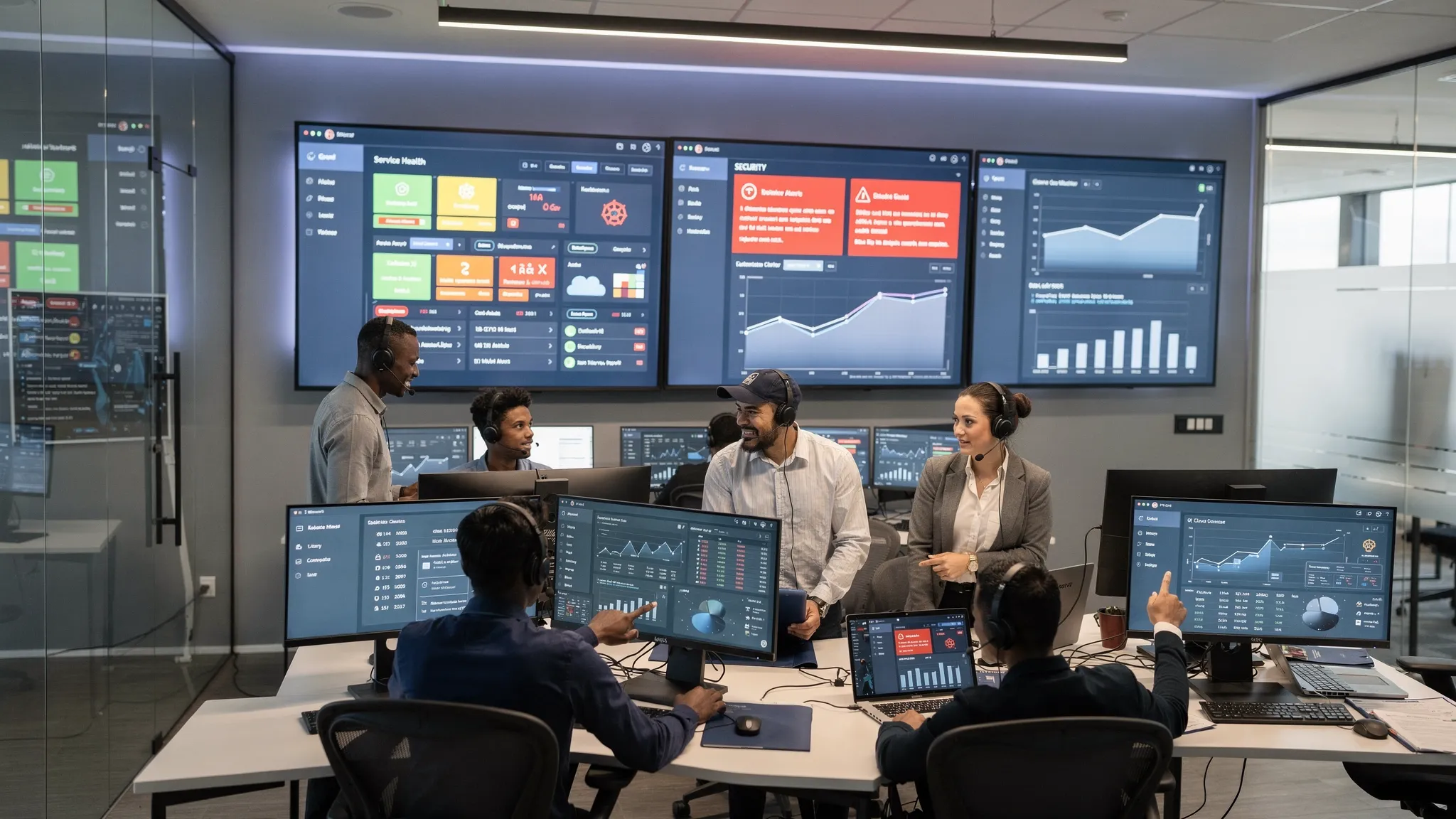
Attack surfaces expanded with remote work, SaaS, and supply chain dependencies. Managed services should implement identity-centric controls, continuous patching, EDR or XDR, hardening baselines, and security posture management. The UK’s National Cyber Security Centre sets useful direction with its Zero Trust architecture guidance.
Expect providers to reference recognised frameworks, for example ISO 27001 and the AWS Well-Architected Framework, and to prove secure-by-default defaults for cloud, Kubernetes, and network.
FinOps is built in, not an add-on
Cloud cost efficiency is now a core outcome. A mature provider will combine engineering discipline with finance guardrails, automated rightsizing, commitment planning, and showback or chargeback reporting. The FinOps Foundation overview is a good primer on common practices.
For related tactics, see our guide to Cloud Performance Tuning.
Compliance automation and operational resilience
Regulation keeps rising. EU financial services operate under the Digital Operational Resilience Act in 2025, and UK organisations continue to meet UK GDPR requirements, see the ICO’s UK GDPR guidance. Expect continuous controls monitoring, audit-ready evidence, immutable backups, and tested recovery.
Connectivity, edge and the modern workplace
Secure access service edge, zero trust network access, and robust endpoint management are table stakes. For manufacturing and retail, providers should manage edge sites and data pipelines that synchronise to cloud analytics platforms.
Sustainability metrics enter the dashboard
ESG reporting pushes providers to quantify the footprint of your workloads. Expect carbon-aware architecture advice and reports sourced from tools like the AWS Customer Carbon Footprint Tool.
What a strong managed IT provider delivers in 2025
Use the table below to evaluate capabilities and dig into proof points during selection.
| Capability | Why it matters | Questions to ask a provider |
|---|---|---|
| Service reliability and SLOs | Aligns uptime and performance with business impact | Which services have SLOs, how are error budgets managed, and how are breaches handled? |
| Security and zero trust | Reduces breach likelihood and blast radius | What is your patching cadence, identity policies, EDR or XDR coverage, and SBOM or supply chain process? |
| Automation and IaC | Cuts toil, prevents config drift, enables rapid recovery | Which stacks do you manage as code, and what is your change approval and rollback process? |
| Observability and AIOps | Faster detection and resolution, better capacity planning | Do you standardise on OpenTelemetry, and what AIOps capabilities are in place for triage and RCA? |
| FinOps and cost guardrails | Keeps spend predictable without sacrificing performance | How do you implement showback, reserved capacity strategy, and anomaly alerting? |
| Kubernetes and platform ops | Consistent deployments, security, and upgrades | How do you handle cluster upgrades, policy as code, and GitOps workflows? |
| Backup and disaster recovery | Meets RTO and RPO targets under stress | What are the tested RTO and RPO by system, and how often do you run game days? |
| Governance and compliance | Reduces audit risk and engineering drag | Which controls are continuously monitored, and how do you present evidence? |
| Reporting and cadence | Visibility for leadership and engineering | What is included in monthly reports and quarterly business reviews? |
If you are planning a migration before managed operations, our overview of cloud migration tools outlines how to de-risk the transition.
SLAs and SLOs to expect in 2025
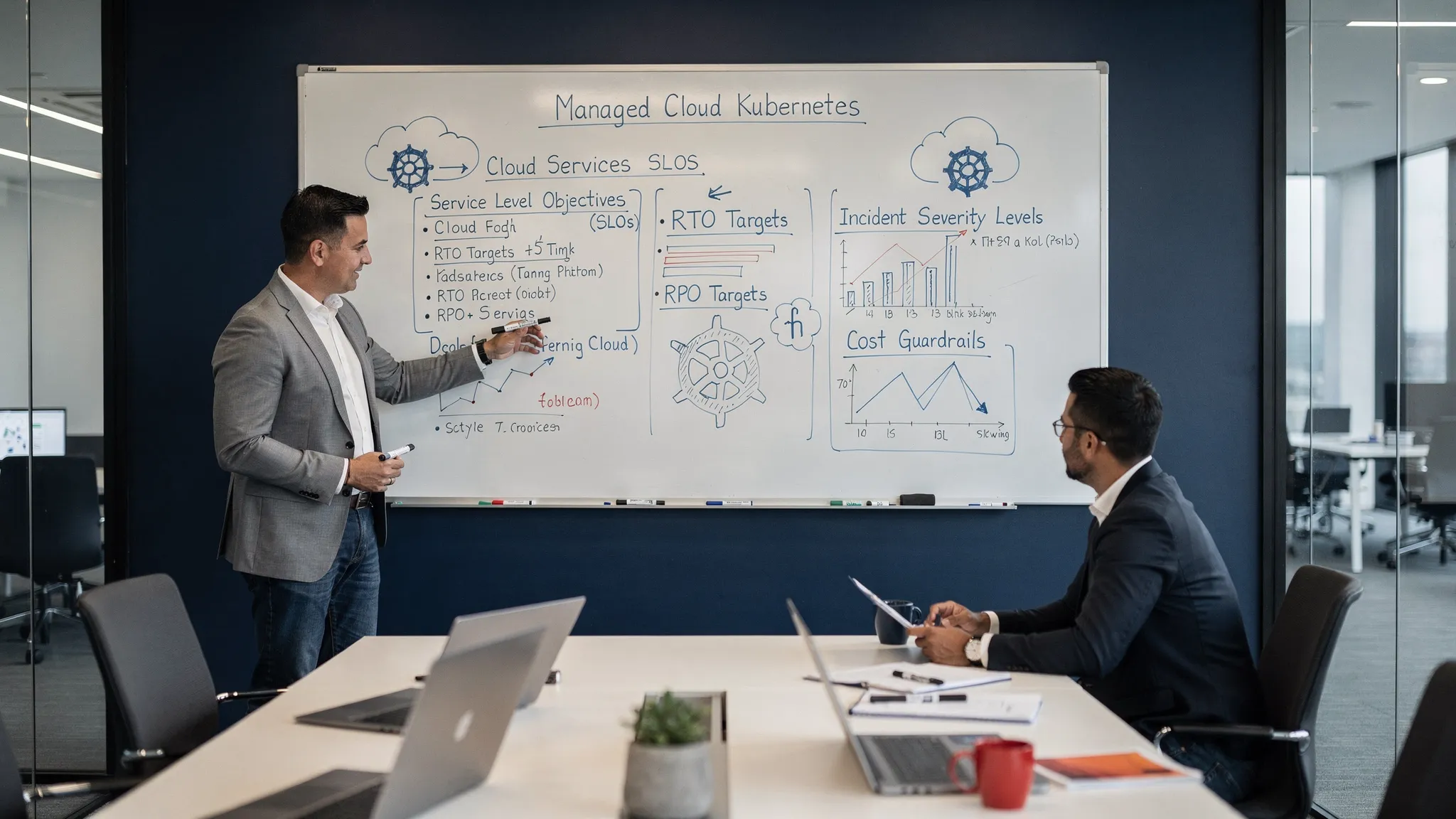
Contracts are shifting toward reliability targets that reflect how users experience your services. The examples below are common structures, your exact targets will depend on criticality and budget.
| Service tier | Typical availability target | Example response target | Example resolution target | Notes |
|---|---|---|---|---|
| Business critical customer-facing | 99.95 percent or higher | 15 minutes, 24x7 | 4 hours to restore service, then full RCA | Includes on-call, change freeze windows, and error budget policies |
| Important internal systems | 99.9 percent | 30 minutes, 24x7 or 8x5 with out-of-hours escalation | Next business day for full restore | Batch processing often fits here |
| Non-critical workloads | 99.5 percent | 4 hours, 8x5 | 3 business days | Cost optimised, scheduled maintenance acceptable |
Key inclusions to look for: severity definitions, maintenance windows, exclusions, service credits, RCA timelines, and joint responsibilities.
Pricing models you will encounter
- Fixed monthly retainer, good for steady state environments with well-defined scope.
- Usage based or tiered by resource, aligns to consumption but requires guardrails and clear unit economics.
- Per user or per device, common for endpoint and workplace services.
- Outcome linked, for example savings realised or time to resolve. Works well when both sides agree measurable metrics.
- Hybrid, a base fee for 24x7 plus variable charges for change projects or burst support.
Ask how the provider avoids surprises, for example monthly forecast reviews, pre-approved change windows, and thresholds that trigger approval before extra spend.
Security, compliance and data sovereignty in focus
In 2025, security controls are continuous, not periodic. A robust baseline includes multi factor authentication everywhere, least privilege, automated patching, vulnerability and misconfiguration scanning, hardening baselines, encrypted backups with immutability, and tested restore procedures. For regulated sectors, verify mapping to ISO 27001 and SOC 2 controls, alignment with PCI DSS v4.0 where applicable, and any EU exposure to DORA. For UK data, ensure processing aligns to the UK GDPR regime via the ICO’s guidance.
The managed service should maintain an always-current asset inventory, software bills of materials for critical apps, and audit trails for access, change, and data lifecycle.
Cloud cost efficiency and sustainability you should see every month
Expect monthly cost and efficiency reporting that includes:
- Waste analysis, unused or low-utilisation resources identified with a remediation plan.
- Commitment and discount strategy, purchase or modify Savings Plans and Reserved Instances with payback analysis.
- Architecture improvements, for example managed data services or event driven patterns to cut idle time.
- Performance tuning, query and cache optimisation that lowers spend and improves user experience.
- Showback or chargeback, clear accountability for product or team budgets.
- Carbon reporting, using provider tools like the AWS Customer Carbon Footprint Tool.
Our article on Cloud Performance Tuning offers practical ideas that pair cost and speed.
A practical readiness checklist for buyers
Use this to prepare for vendor conversations and speed up onboarding.
- Define critical services, RTO and RPO targets, and any legal or regulatory obligations.
- List current tools and gaps, monitoring, logging, backup, vulnerability management, ticketing.
- Set incident policies, on-call expectations, communication channels, and escalation paths.
- Agree change management, approval workflow, deployment windows, and rollback standards.
- Confirm identity and access baselines, SSO, MFA, privileged access, joiner and leaver automation.
- Align on reporting, weekly operations updates, monthly metrics, quarterly business reviews.
- Clarify cost guardrails, forecast cadence, approval thresholds, and showback model.
- Decide what stays in-house versus provider owned, responsibilities and decision rights.
How Tasrie IT Services approaches managed operations
Tasrie IT Services focuses on measurable outcomes driven by senior engineers. We help teams ship faster, improve reliability, and reduce costs across:
- DevOps consulting and CI or CD automation that remove manual release bottlenecks.
- Cloud native and Kubernetes operations with GitOps and Infrastructure as Code.
- Monitoring and observability powered by open standards, see our guide to observability.
- Cloud migration and management on AWS, plus platform hardening and performance tuning.
- Cybersecurity services that align to zero trust principles and audited best practices.
- Business process automation and data analytics to turn telemetry and events into action.
If you are exploring GitOps as part of your 2025 roadmap, read our overview of ArgoCD benefits, and for migration planning, our cloud migration tools guide can help you map the journey.
Frequently asked questions
What has changed in managed IT services for 2025? AI assisted operations, platform engineering, and embedded FinOps are now standard. Providers are expected to deliver SLO based reliability, zero trust security, and cost guardrails as part of the core service.
Do I really need 24x7 coverage? It depends on the business impact of downtime. Public websites, customer transactions, and revenue pipelines typically warrant 24x7. Internal line of business systems may be fine with enhanced 8x5 and on call escalation.
How should a modern SLA be structured? Include availability and performance SLOs, incident severities with response and resolution targets, maintenance windows, exclusions, service credits, RCA timelines, and joint responsibilities for change and access.
Where does AIOps add the most value? Event correlation, anomaly detection, incident summarisation, and automated remediation. The biggest benefits come when telemetry is unified, for example with OpenTelemetry, and runbooks are codified.
How are services priced in 2025? Common models include a monthly retainer, usage based tiers, per user or device for workplace services, and outcome linked fees. The right model balances predictability with flexibility and should include clear guardrails.
How do compliance requirements affect scope? If you operate in regulated markets or in the EU, expect additional controls, evidence packs, and testing for resilience, for example DORA for finance. In the UK, ensure alignment to the UK GDPR and industry standards like ISO 27001.
Ready to modernise your managed IT in 2025?
If you want managed services that combine DevOps speed with enterprise grade reliability and security, speak with Tasrie IT Services. We bring senior engineering, cloud native expertise, automation, and clear reporting so you can focus on delivery.
Start a conversation at Tasrie IT Services. We will map your goals to a pragmatic plan and show early wins in weeks, not months.