 ChatGPT
 Perplexity
 Claude
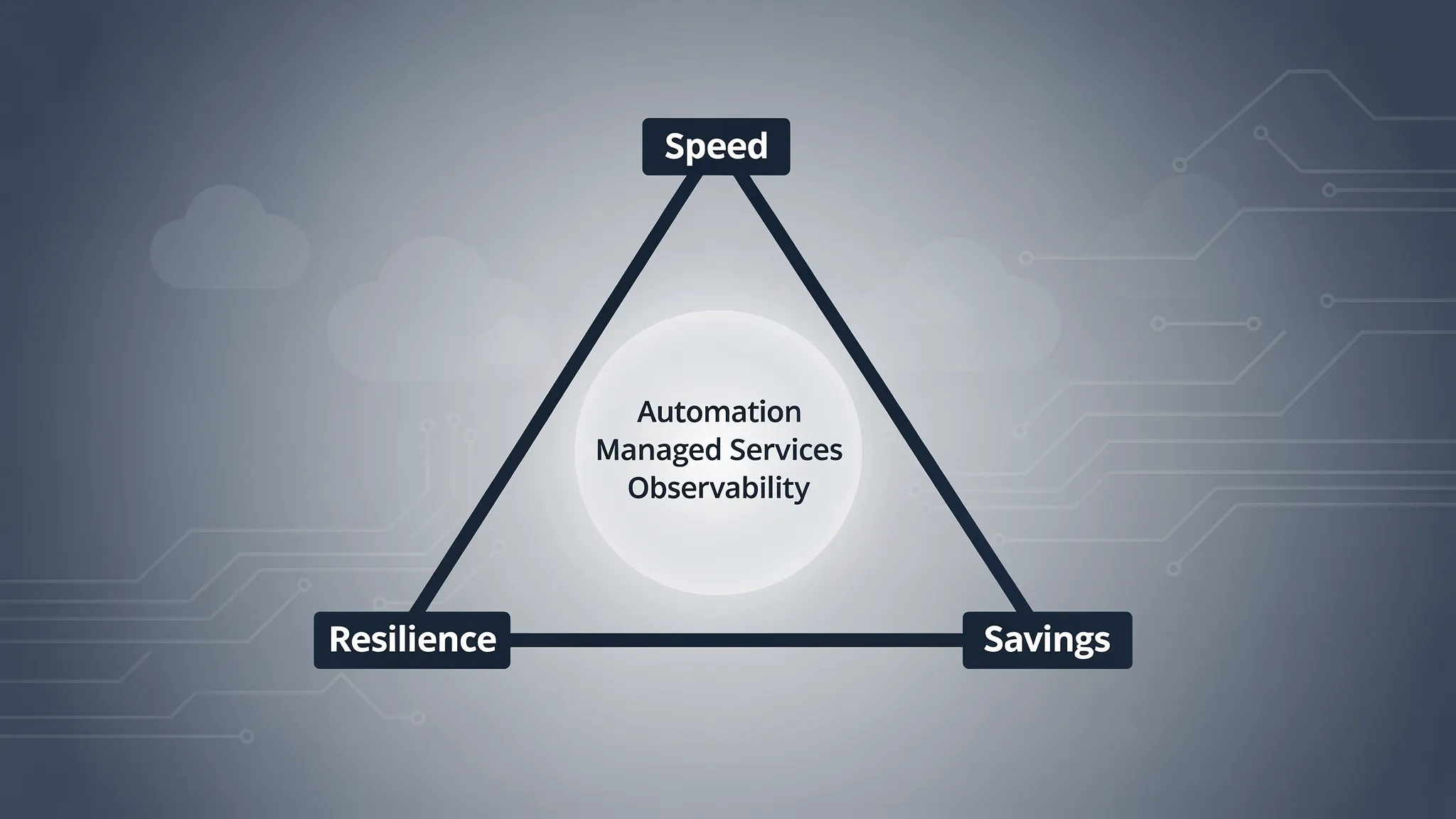
Cloud adoption is often sold as a vague promise of “modernisation”. In practice, the value is much more concrete: cloud technology benefits tend to show up in three measurable areas that executives and engineering teams care about most: speed (time to ship), resilience (ability to stay up), and savings (cost per unit of value delivered).
The key is that these outcomes are not automatic. The cloud gives you new primitives (elastic compute, managed services, automation APIs), but you still need the right architecture, delivery practices, and operational discipline to realise the upside.
What “cloud technology” really changes (beyond hosting)
When teams say they’re “moving to the cloud”, they often mean more than relocating servers. The real shift is from infrastructure you manually build and maintain to on-demand services you can provision, scale, secure, and observe via code.
That shift is enabled by a few foundations:
- Elasticity: capacity can scale up or down with demand.
- Programmable infrastructure: everything has an API, which makes automation practical.
- Managed services: databases, Kubernetes control planes, queues, identity, monitoring, security controls.
- Global building blocks: multi-region/multi-zone capabilities for resilience.
If you want a vendor-neutral definition, the NIST definition of cloud computing is still the most cited baseline.
Cloud technology benefit #1: Speed (ship faster with less friction)
Speed is not only about developer velocity. It is about how quickly your organisation can turn an idea into a reliable change in production.
Why cloud increases delivery speed
Cloud platforms reduce (or eliminate) “waiting” in the delivery lifecycle:
- Self-service environments: teams can create dev/test/staging environments without ticket queues.
- Infrastructure as Code (IaC): repeatable provisioning (and fewer “works on my machine” surprises).
- Managed services: less time operating undifferentiated components (patching, backups, HA setup).
- Automated CI/CD: faster, safer releases through consistent pipelines and quality gates.
A useful way to make “speed” measurable is to track the DORA metrics (deployment frequency, lead time for changes, change failure rate, and time to restore). Google’s DevOps Research and Assessment (DORA) popularised these as practical indicators of software delivery performance.
Speed levers that actually move metrics
| Speed lever | What changes in day-to-day work | How to measure improvement |
|---|---|---|
| IaC (Terraform/CloudFormation) | Environments become reproducible and reviewable | Provisioning time (hours to minutes), fewer config drift incidents |
| CI/CD automation | Releases become routine instead of “events” | Lead time for changes, deployment frequency |
| Ephemeral preview environments | Testing happens earlier with realistic infra | Defect escape rate, cycle time |
| Managed data services | Less operational toil for databases/queues/caches | On-call load, planned maintenance hours |
| Platform “golden paths” | Teams reuse proven patterns | Time-to-first-service, onboarding time |
If your team wants a pragmatic blueprint for this kind of acceleration, a DevOps assessment that maps constraints across people, process, and platform is typically the fastest way to prioritise (see Tasrie’s perspective on a DevOps strategy and assessment).
Cloud technology benefit #2: Resilience (stay available when things fail)
Resilience means your systems continue delivering an acceptable service level even during failure scenarios (hardware failures, traffic spikes, dependency outages, deployment mistakes, and security events).
Cloud platforms help because they provide:
- Multi-Availability Zone primitives (and multi-region options when needed)
- Autoscaling and load balancing capabilities
- Backup and disaster recovery building blocks
- Observability services and integrations
However, resilience is primarily an engineering outcome. You only get it when you design for it.
Reliability patterns that map directly to cloud capabilities
The AWS Well-Architected Framework is a strong reference for reliability principles (even if you are not on AWS). In practical terms, resilience comes from a small set of repeatable patterns.
| Resilience pattern | What it protects you from | What it looks like in cloud |
|---|---|---|
| Multi-AZ design | Single data centre or AZ failures | Redundant services across zones, health checks, automated failover |
| Autoscaling (horizontal and event-driven) | Sudden load spikes and seasonal demand | Scaling policies driven by CPU, latency, queue depth, custom metrics |
| Automated rollback and progressive delivery | Bad releases causing outages | Blue-green/canary releases, automated rollback on SLO burn |
| Backups + tested restore | Data corruption, accidental deletion, ransomware recovery | Versioned object storage, point-in-time recovery, immutable backups |
| Observability with actionable alerts | Slow detection and long incident resolution | Metrics, logs, traces, and alerting tied to user-impact signals |
Resilience also includes operational readiness: runbooks, on-call practices, and meaningful service objectives. If you want an operations-focused implementation approach, this guide on cloud operations management (runbooks, SLOs, automation) pairs well with platform work.
Cloud technology benefit #3: Savings (lower total cost and better unit economics)
Cloud savings are often misunderstood.
Yes, moving from CapEx to OpEx can help cash flow, but the strongest financial advantage usually comes from:
- Elasticity: you stop paying peak capacity 24/7.
- Automation: fewer manual operational tasks and fewer incidents.
- Optimised architectures: managed services, serverless, rightsizing, and modern instance families.
- Faster delivery: business value arrives sooner, which is a real (but often uncaptured) economic gain.
Where cloud savings actually come from
| Cost area | Common “waste” pattern | Cloud-native control that reduces spend |
|---|---|---|
| Compute | Always-on, over-provisioned VMs | Autoscaling, rightsizing, scheduling non-prod |
| Kubernetes | Cluster sprawl, poor requests/limits | Resource governance, bin packing, spot strategies |
| Storage | Keeping everything on premium tiers | Lifecycle policies, archival tiers, retention controls |
| Data transfer | Unplanned egress and chatty architectures | CDN, caching, regional placement, traffic shaping |
| Tooling | Paying for overlapping platforms | Consolidation, open standards (where sensible), cost visibility |
One important caveat: cloud cost optimisation is an ongoing practice, not a one-off migration task. Many teams see spend increase initially because they replicate on-prem patterns in the cloud or lack cost visibility.
If you want a structured approach, a FinOps-style routine (visibility, optimisation, governance) is usually the difference between “cloud is expensive” and “cloud is efficient”. Tasrie’s AWS cloud cost optimisation guide goes deep on practical measures.
The trade-off: you rarely maximise speed, resilience, and savings by accident
These three benefits reinforce each other when engineered intentionally:
- Speed without resilience leads to frequent incidents and reputational risk.
- Resilience without cost discipline leads to over-engineering and runaway spend.
- Savings without speed often means cutting capacity or capability in ways that slow delivery.
A useful executive-level framing is to pick a small set of outcome metrics and treat them as a scorecard:
- Delivery: lead time for changes, deployment frequency
- Reliability: availability SLO, p95 latency, MTTR
- Cost: cost per transaction (or per customer), environment cost by team/service
How to realise the benefits: a pragmatic starting plan
If you want cloud benefits you can defend in a quarterly review, focus on sequencing.
1) Baseline before you change anything
Establish a “before” snapshot:
- Delivery metrics (even if imperfect)
- Incident history and MTTR
- Current infrastructure and operational costs
- Key risks (security, compliance, end-of-life platforms)
2) Build a secure, repeatable foundation
This is where landing zones, identity, networking, logging, and guardrails live. Without this, teams create one-off environments and operational risk grows.
3) Automate delivery and operations early
Prioritise:
- IaC for provisioning
- CI/CD with repeatable quality gates
- Observability and alerting that reflects user impact
4) Modernise in thin slices
Rather than a “big bang” rewrite, thin-slice migrations (or targeted modernisation) reduce risk and prove value quickly.
When cloud is not the best answer (or needs a hybrid approach)
Cloud is not automatically the right fit for every workload. You may need a hybrid model if:
- You have strict data residency constraints with limited provider coverage
- Ultra-low latency requirements demand edge proximity
- Legacy licensing makes cloud economics unattractive without redesign
- The organisation cannot yet operate cloud safely (skills, governance, security maturity)
Hybrid is not a failure. It is often a valid stage, as long as you standardise security and operations across environments.
Real-world proof points (without the hype)
Tasrie IT Services regularly sees the speed-resilience-savings triangle show up in measurable outcomes, especially when cloud adoption is paired with DevOps and automation.
If you want concrete examples:
- Cost reduction through migration and optimisation: migrating finance applications to AWS for 30% cost reduction
- Kubernetes cost optimisation: 30% reduction in an AWS EKS monthly bill
- Resilience at scale with multi-cloud Kubernetes: 99.99% uptime with multi-cloud Kubernetes
Frequently Asked Questions
What are the biggest cloud technology benefits for most organisations? The most consistent benefits are faster delivery (speed), improved uptime and recovery (resilience), and lower cost per unit of value (savings). The key is to align cloud work to measurable outcomes rather than “moving servers”.
Does moving to the cloud automatically reduce costs? Not automatically. Many teams see an initial increase if they lift-and-shift without rightsizing, cost visibility, or governance. Sustainable savings usually come from FinOps practices, automation, and architecture changes that take advantage of cloud elasticity.
How does cloud improve resilience compared to on-prem? Cloud providers offer multi-zone infrastructure, managed services, and automation capabilities that make high availability and disaster recovery easier to implement. You still need to design and test failover, backups, and incident response processes.
Which metric best proves cloud value to leadership? A simple scorecard works best: lead time for changes (speed), availability SLO and MTTR (resilience), and cost per transaction (savings). These connect cloud engineering work to customer and financial outcomes.
How long does it take to see benefits after adopting cloud? Many teams see early wins in weeks (environment provisioning, CI/CD reliability, better monitoring). Larger benefits (unit cost reduction, mature resilience, operating model improvements) typically take a few months of focused iteration.
Turn cloud benefits into measurable outcomes with Tasrie IT Services
If you want cloud technology benefits you can actually measure, the fastest path is usually an outcomes-led engagement: baseline your current state, design the right foundation, automate delivery and operations, then modernise in thin slices with cost and reliability guardrails.
Tasrie IT Services specialises in DevOps, cloud native and Kubernetes consulting, automation, and observability, with a focus on measurable delivery speed, reliability, and cost outcomes.
Discuss your goals with the team at Tasrie IT Services or explore their approach to cloud engineering best practices for high-scale teams.